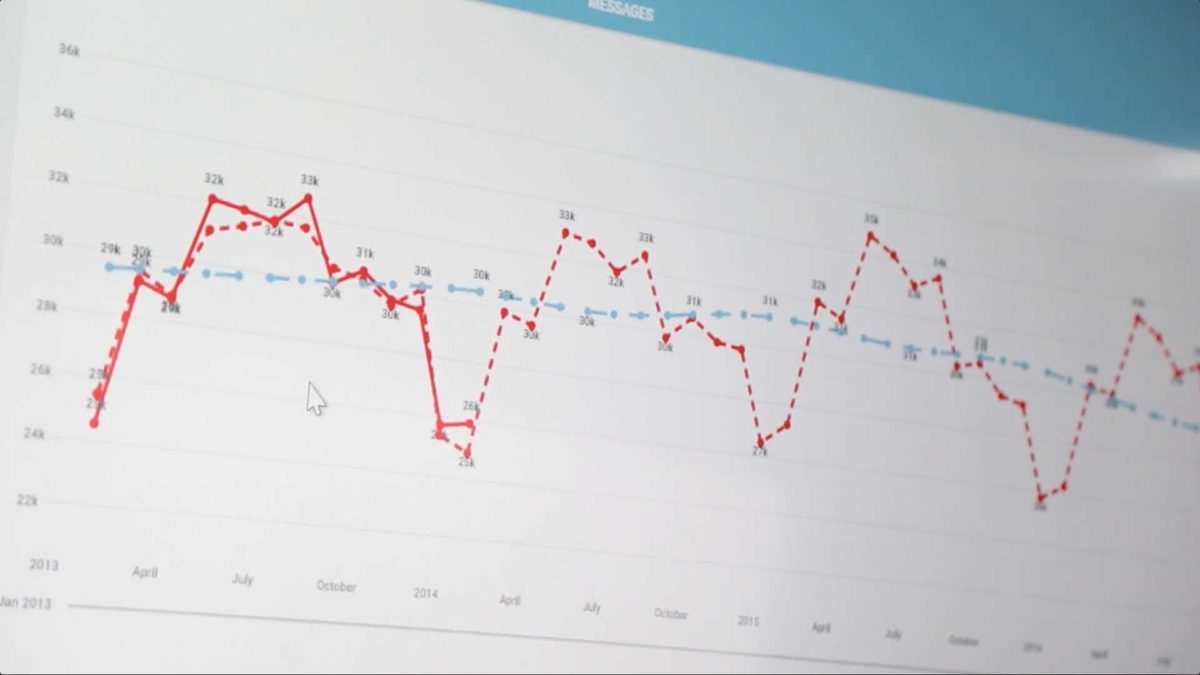
Information Markets or Prediction Markets are an interesting phenomenon. They basically work the same as stock exchange markets, but instead of buying or selling shares in a company, you buy or sell a contract predicting a certain event. For example, the event could be: Hillary Clinton wins the 2016 presidential elections. If you believe the chance of this happening is higher than the current value of the contract, you would buy the contract and if you are correct you would make a profit. So basically, a chance of 100% would have a cost of €1, while 0% would be €0 in value. Anything in between then becomes the chance of this event happening as predicted by the market. This means that if the contract sells for €0.70, the market says there is a 70% chance of this happening. Research into prediction markets has found that these predictions are generally as accurate or more accurate than the predictions of individuals, even if they are experts.
This may sound like something incredibly useful and that we can now predict everything before it has happened and so prevent bad things from happening, or at least be prepared for them. However, it’s important to realize that prediction markets are not fortune-tellers: it is not true that you ask a big group of people at any point in time what they predict will happen and that this will be accurate. Instead, it just means that the wisdom of the crowd tends to be more accurate than individual wisdom, but it is still based on the information that is available at that time. So if that information suddenly changes, the predictions will also shift suddenly. Over time, the predictions will become more accurate, which makes sense since there is less chance of something really big happening, and more information is already available. This means that prediction markets are a really good information aggregation tool: we can generally accept that its prediction will be based on all the information available at that point in time.
I would be very interested in seeing how accurate predictions are for which not much information is available, or where people are not given the chance to gather more information. Would predictions still be very accurate? Either way, I’m fascinated by this concept, as I think there are still many valuable applications in which this idea could be used.

Hello Eva!
The topic of prediction markets and forecasting is a topic that I also find a very interesting one.
In particular, the second paragraph of your article touches upon a very important element of the prediction markets and forecasting tools: Uncertainty. Indeed, predictions and forecasting take places always with a significant margin if error. Yet, even if this error and uncertainty is managed with risk management tools, still the risk and impact of an erroneous prediction can be disastrous.
This is best presented in the book “The Black Swan: The Impact of the Highly Improbable” by Nassim Nicholas Taleb. There, N. N. Taleb disscusses how a highly improbable event can have a very destructive impact, when forecasting models are built with the assumption that low probability of a negative event can be considered as zero.
Such a negligent approach to highly improbable, yet destructive events, took place in the 2007/2008 world financial crisis, with disastrous effects.
Finally, let me express my appreciation to you for posting this article. Your idea to talk about predictions and forecasting was very interesting and I really liked your article.
Kindly Yours,
Anargyros Berdekas
Hi Anargyros,
That’s a good point, indeed the financial crisis is a good example. I was wondering, though, wouldn’t you realize over time that the probability of this improbable event is increasing? For example, there were people who predicted the financial crisis, because there were red flags and other signals showing this. If we were to continuously update or re-assess the probability of an unlikely event, do you think this would help for this issue?
Hi Eva, thanks a lot for this interesting blogpost. I do agree that prediction markets are useful and will be more and more important in the future as well. However, a concern related to prediction markets is group thinking, which can lead to an irrational decision-making outcome. To solve this problem, prediction markets can use the blockchain-technology, which makes it possible to store information in many small, decentralized, encrypted blocks. Later on, the data from these blocks will be aggregated. In this way, it would be possible for individuals to do independent predictions, without having direct contact with the other predictors. The prediction markets will likely be more accurate and therefore be more valuable to both individuals and organizations!
Hi Robin,
Interesting point. So these small, decentralized blocks would not have any way to interact with each other, right? I was thinking about this as well while writing the article, how in the end prediction markets are still based on the opinions of experts as well (even though prediction markets tend to give a better prediction than experts). So it seems that it’s really the aggregation of all the different information that seems to make it possible to give the correct weight to already existing predictions that the people in the prediction market base their choice on. But if that is the case, then wouldn’t group thinking be a small enough problem that it does not really matter? Since people are already basing their opinion on that of others, but it seems this somehow balances out and comes to a (relatively) accurate prediction anyway.
Hi Eva,
Thanks for your post! It’s amazing to see how the value created by a group’s combined knowledge can (mostly) be higher than the value created by one individual who has expertise in the field. To add to your post, I think it’s quite interesting to mention that although one can manipulate a prediction market by flooding it with high bets, the manipulation itself has a short life cycle. In cases where there is not a lot of public information available, maybe they are still able to predict somewhat accurate statements if they combine the two knowledge sources given above: the creativity of the crowd with the judgment of an expert?
– http://thenoisychannel.com/2010/06/09/why-cant-we-just-use-prediction-markets
Hey Shannon,
Thank you for your response, I’m glad you liked the post!
About your point related to markets with little information, I think it would make sense in all cases that the more sources you use to base your prediction on, the more accurate it will be, so long as you manage to give the right weight to different sources. The prediction market apparently is really good at figuring out this weight collectively, which is probably why it works. However, if we had a market with very little information, I would also consider that to mean that expert opinions are not available (or at least not publicly available). So I agree with your point that it is good to combine different knowledge sources. What I originally meant with my point about cases with little public information is that I would be interested to see what kind of prediction people will make if they have little to base it on. Will it balance out because of the number? Or would people become strongly influenced by each other and move to more extremes?