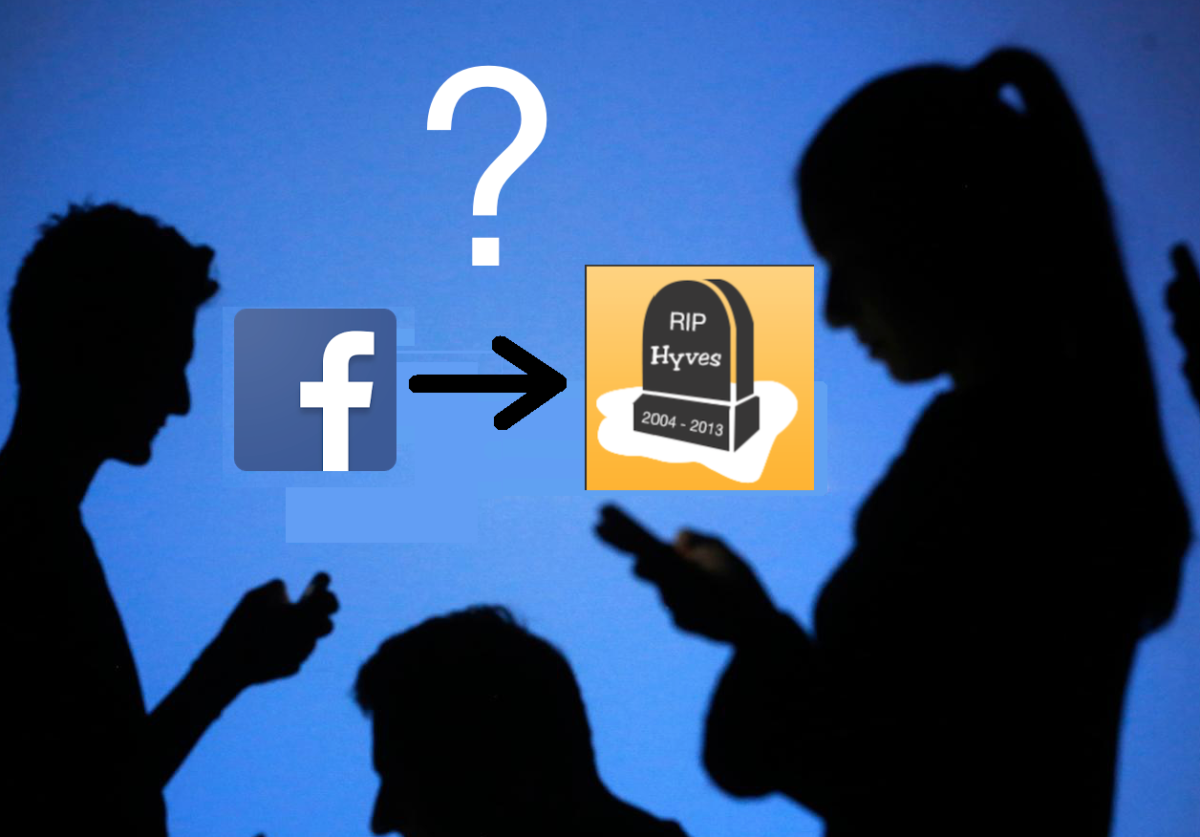
Probably every dutch student remembers the good old time of Hyves. For those who are not familiar with it, a short explanation follows. Hyves was a social media platform were you could connect with friends, post pictures, status updates and push on a button to give a ‘respect’ to others. Sounds familiar? It probably does, Hyves was basically the Dutch version of Facebook. It had the same features and it was a popular as Facebook is nowadays. In may 2012 Hyves counted 10 million Dutch users and had 5 million unique visitors a day and it got acquired by the Telegraaf Media Group for nearly €50 million, which was mind blowing back then.
However, nowadays Hyves as a social media platform does not even exist any more. Why? There were too many substitutes that were more popular. Although it is hard to imagine a world without Facebook, from a theoretical perspective it can follow the same destiny as Hyves. Funny enough there are some striking examples showing that Facebook is extremely aware of this fact. Look at the following two acquisitions:
9 April 2012 Instagram for $1 billion.
19 February 2014 WhatsApp for $19 billion.
Although the majority of the news articles consider those acquisition as a positive development for Facebook, arguing that the strategic value behind them is almost priceless, there are also some more negative voices. Those two company’s had in common that they were a threat to Facebook, as Facebook was for Hyves. Facebook did it best to come up with its own Facebook messenger, however, it did not work out. Facebook did it best to be the biggest photo sharing platform, however, it neither worked out. Instead of investing in their own platforms they simply bought the ones who were better and threatening Facebooks future. This could of course be a perfect business strategy, if it is at least is your business strategy. Mark Zuckerberg mentioned the following after the purchase of Instagram: ” This is an important milestone for Facebook because it’s the first time we’ve ever acquired a product and company with so many users. We don’t plan on doing many more of these, if any at all.” This statement makes the purchase of WhatsApp, less than 2 years later, look like a kind of ‘panic football’.
But as long as it works it works. Facebook made a profit of roughly $3 billion in 2015 and accomplished a $1 billion profit in the first quarter of 2016. Besides, it is not just ‘panic football’, Facebook is playing. On the 25th of March 2014 Oculas VR was acquired for $2 billion. With this new technology, which was not directly a competitor of Facebook, the company is preparing itself for the future by distinguishing from competitors.
And it will probable be this path, Facebook has to follow, if it wants to avoid a destiny like Hyves encountered. Only by being a better alternative compared to other social media platforms, like Snapchat, Pinterest, Twitter and Vine, Facebook will be capable of keeping its critical mass of users that is necessary to stay alive.
References:
https://nl.wikipedia.org/wiki/Hyves
https://en.wikipedia.org/wiki/List_of_mergers_and_acquisitions_by_Facebook
https://www.theguardian.com/technology/2014/jul/22/facebook-oculus-rift-acquisition-virtual-reality
http://www.businessinsider.com/why-facebook-buying-whatsapp-2014-2?international=true&r=US&IR=T

The problem with Hyves was that it was only focused on the Dutch market. Facebook emerged in the Netherlands, providing larger two-sided network effects, as it allowed Dutch users to also connect with their international friends and family. Facebook really was a substitute for Hyves, while I consider applications such as Snapchat, Instagram, Twitter to be complementary to Facebook, and will thus not drive users away from it. Facebook should be wary of its treats, but it will be extremely difficult to remove Facebook from the playing field.
Hi Jochem,
Thank u for writing this interesting post. I remember the time that I made use of Hyves, thinking it was the best thing ever. And indeed, now I cant imagine a life without Facebook. But sometimes something in me wants to see Facebook fall and that we all get caught up with a new type of social media. I was wondering if there werent any other reasons why Hyves collapsed. I have read a couple of years a go that the Telegraaf group did not had the right management skills to lead hyves in achieving the objectives.
Before hyves there was pp2g. I don’t know if you know this platform? It was also a very popular social network were people could get even more creative in designing there own page with different colours, photos, graphical effects et cetera. You could even see who visited your page. And after pp2g, there was also FiestaInfo. This platform wasn’t that popular in regards to pp2g or Hyves. Maybe these social networks have a common factor being the reason of why they collapsed.
For now, we need to live with Facebook. I think we got to attached to Facebook. Thank you for bringing me back to the good old days with this blog.
Kind regards,
Hajar Azrioual
Dear Jochem, thank you for your post! I think that there is one important thing that Facebook has that Hyves did not: it is an international platform. Hyves was solely used by Dutch people, and Facebook actually allowed them to stay in touch with their friends abroad. Hence, I think this is a large reason why Hyves failed, and also a good reason as to why Facebook will stay in existence for now – network effects. Facebook is still one of the main ways of communication, especially for group projects (or even for whole studies – such as our BIM Facebook group). However, I also agree to Facebook needs to keep up with ongoing trends, and that the two large acquisitions they made will help them to stay in the game. But, they need to be carefull with how they handle data (for example, Whatsapp announced that it would share data with Facebook, which made a lot of people unhappy). Thus, Facebook needs to clearly listen to its users, and ensure their privacy – as people’s main reasons to quit facebook is their privacy policy. Thus, only be ensuring users privacy and keeping them happy, I believe Facebook can keep existing.
http://www.independent.co.uk/life-style/gadgets-and-tech/news/whatsapp-facebook-terms-private-data-sharing-opt-out-how-to-a7210841.html
http://healthland.time.com/2013/09/19/behind-the-unlikes-understanding-why-people-quit-facebook/
http://www.volkskrant.nl/media/de-opkomst-en-ondergang-van-hyves-hoe-heeft-het-zo-ver-kunnen-komen~a3536726/
Hi Jochem,
Thanks for sharing! I do agree with the fact that it will be tough for Facebook to maintain its current user base. I don’t think, however, that Facebook’s situation is 100% relatable to Hyves’ situation back in 2012. I think Hyves went down because Facebook could totally cover all the functionalities Hyves had to offer, but better. In addition, the fact that it was internationally oriented was a big advantage for Facebook over Hyves. The situation Facebook finds itself in nowadays is not comparable to this because it gets ‘attacked’ on specific parts of the platform and not its entirety. My guess is that user activity will definitely decrease for Facebook, but that Facebook will remain a good place to go to find a short bundled overview of someone’s life/activities. Checking someone’s Twitter first, then Instagram and then Snapchat could become very annoying to obtain a complete picture of someone’s life.
Hi Jochem,
Thank you for your blog post! I like your post very much, because I was an avid fan of Hyves. When I enrolled for high school, I added all my new classmates on Hyves. I spent sooo much time on Hyves those days, I can’t imagine my high school without Hyves.
Nowadays, this is the same with the blue giant: Facebook! Every day I check my Facebook more then ones. It became a part of our lives. I think Facebook will be more than just a social media platform.
If we take a look at the Chinese app market, there is an app called ‘WeChat’, which is a universal platform. The app includes multiple features, like communication, social media, online payment, online-dating (like Tinder), order a taxi (like Uber), and many more. WeChat has 700 million users in China!
I think, Facebook will shift from a social media platform, to a universal service platform, like WeChat. Facebook already started; they will plug 700 apps into Facebook Messenger before 2017.
What do you think of this?
Kind regards,
Alexander Mik