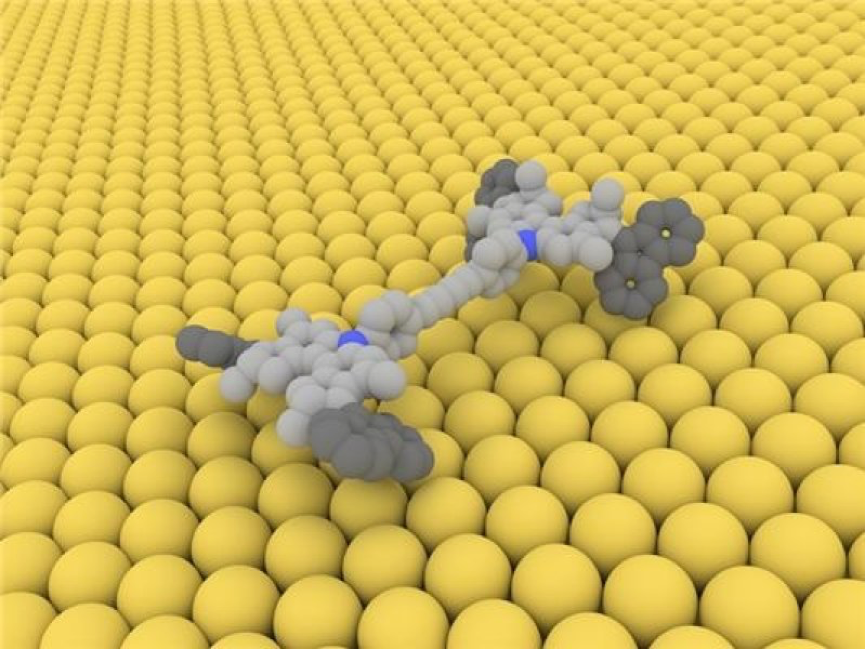
You have probably seen or heard about Formula One(F1) Car Race. But do you know there is an upcoming nanocar race? The first ever nanocar race will be held in Centre national de la recherche scientifique (French National center for scientific research) from 14th to 15th of October in Toulouse. The molecular cars designed by several groups from different countries’ lab will compete on a nano-size racetrack. By stimulated by electrical pulses, these cars will move around hundreds of nanometers with 2 turns, indicating that researchers are able to manipulate the molecular machines, which are in nanometer scale.

Molecular machine is numbers of molecular components that produce mechanical movement under specific stimuli. It has been a dream of scientists for more than half a century to shrink machines to nanometer scale after the famous speech by Richard Feynman.
In fact, molecular machine provides many possibilities in the revolution of science and engeneering. The most notable example is smart drugs, which will be possible to target the virus in the body. “Think about tiny little robots that the doctor would inject into your bloodstream, and that would go search for a cancer cell or deliver a drug,” described by Ben Feringa, the winner of Nobel Prize in chemistry in 2016. Although plenty of researches should be done to guide us there, imagine how many health data from a nano scale point of view will be delivered by the molecular robot?
Besides, some researchers (Luo, et al, 2002) built up molecular memory chips. The researchers think the small size of these chips can challenge the traditional silicon chip that currently as small as 20 nanometers in the lab. However, a molecular memory chip would be at most 1 nanometer, which means that the molecular chips can store 20 times of information as that current chips can store. You know how information is of importance at this internet age. The human knowledge that need to be digitally stored is doubling in size every 12 months. And network information is almost doubling every 12 hours.
From the developing point of view, the molecular machines are like the electrical motors invented in 1830s. When the scientists looked at these motors, they could not predict that these motors would be employed in trains, washing machines, fans et al. Although it is too early to say that how deeply the world will change because of the molecular machines, by controlling the movements of the machines we have made the first step to the new world.
Reference:
Luo.Y, Collier.C.P, Jeppesen.J.O, et al. 2002. Two‐dimensional molecular electronics circuits. ChemPhysChem 3.6 (2002): 519-525.
http://nanocar-race.cnrs.fr/indexEnglish.php
http://www.emc.com/leadership/digital-universe/2014iview/executive-summary.htm
http://www.industrytap.com/knowledge-doubling-every-12-months-soon-to-be-every-12-hours/3950

Hey Beibei! Thank you for posting such an interesting article! I agree with you that this technology can be a game changer which might revolutionize our life. Even though there has not been a concrete proof yet as to how this technology could be beneficial for our life, but the promises that it ought to bring is just too good to be ignored.
Nissan has implemented this technology under the name Nissan Shield Technology. I think that this shows the recent concrete example of the implementation of molecular technology, other than the nanocars. However, the societies are skeptical about this technology, as the commonly see it as ‘cute toys’. While there is still a long road ahead, I believe that this technology can be useful! One day, we might see a headline news stating that there is tiny little machine inside of our body that is delivering the drugs and medicine. We are at the revolution industry where technology has been developing rapidly and we know no boundaries of improvement. It is just the same when they invented the laser or electric motors, of which they were not exactly sure either what those technologies are capable of.