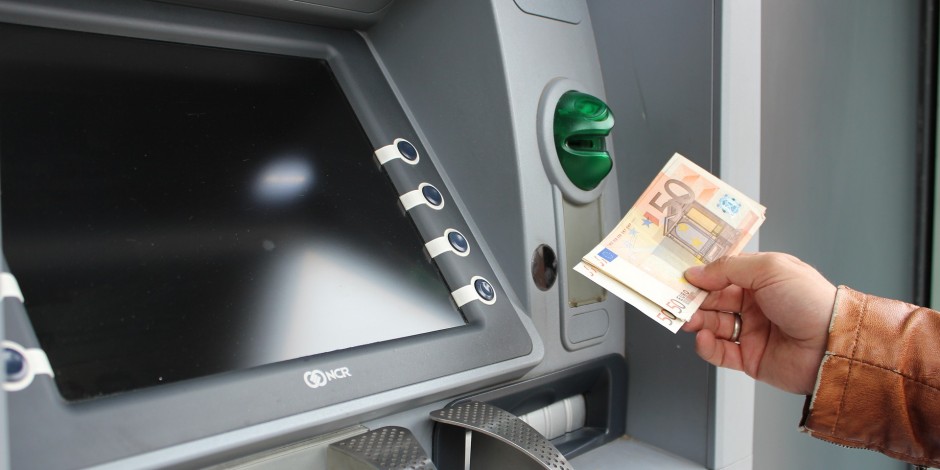
“Huh? The ATMs have a future?” This question might cross your mind when your read the title.
Comparing to the rest of the world, European countries are rapidly moving toward to a cashless society. An increase in the use of debt or credit and the introductions of different digital payment system make cashless possible. Sweden, for example, is on track to become the world’s first cashless society. cash transactions made up barely 2% of the value of all payments in the country in 2015 and 96% of the population has a least one debit card. (Ray, 2015) The need of ATMs has thus significantly and rapidly decreased. Between 2010 and 2012 alone, 900 cash machines were removed. (Jones, 2016) Similarity, in the Netherlands, the share of noncash payments of total value of consumer payments is about 85%! (Ray, 2015) Also, by 2018, 60% of Dutch retail payments are assumed to be cashless. (Betaalvereniging Nederland, 2015) It simply seems that there is no future for ATMs and they are soon to be gone, but It does!
Even though the amount of ATMs will definitely decrease over the years, I do think that there is still a need of having ATMs in the next 10 years, especially since many banks are reducing their branch numbers due to the increased use online banking. People would need ATMs to get cash. Although this occasion would probably not happen often, the need is still there and need to be fulfilled unless no store accept cash anymore. New functions are also now added to ATMs in order to replace bank branch and increase usability of the machines. For example, new UBS machines in Switzerland enable people to open bank accounts; instead of cash, they spit out a brand new debit card. Other functions such as loan payment, credit card payment ,and branch-like level of customer service are also can be found in some banks’ ATMs. The most important ATM innovation is however, the allowance of cardless access. Consumers can either use the bank’s app on their phone, or through a mobile wallet. Using the app, customers obtain a temporary PIN, then they enter it on ATM to withdraw money. This would prevent identity thefts, and thus strongly improve the security of ATMs. The use of biometric authentication system is another way to enable cardless access. For example, I can withdraw money from my Taiwanese bank’s ATMs with my finger thanks to vein pattern recognition technology.
Besides adding more bank functions and increasing security, the ATMs industry is continuously innovating. Michael Lee, the CEO of the ATM Industry Association, stated that the game changer of ATMs is most likely to be robotics. Quantum Systems, a system that is definitely just an ATM, can also serve as bank teller services, safe-deposit box, vending machine and insurance office with the help of robotic arm. It is still too costly to realize this system, but Lee thinks it will be available in 2020s.
I think ATMs will still be around in the next few years since our need to grab some cash isn’t fading away easily anytime soon. Also, the upgraded ATMs can do not only withdrawing cash, but also most of the work of a bank branch, thus increase the importance and usability of ATMs.
Bibliography
https://letstalkpayments.com/which-countries-are-close-to-a-cashless-world/
http://www.thedrum.com/opinion/2016/08/25/how-far-away-are-we-cashless-society
http://www.atmmarketplace.com/articles/2016-in-the-atm-industry-for-europe-a-year-of-heavy-lifting/
https://www.betaalvereniging.nl/wp-uploads/2016/07/Annual-Report-Dutch-Payments-Association-2015.pdf