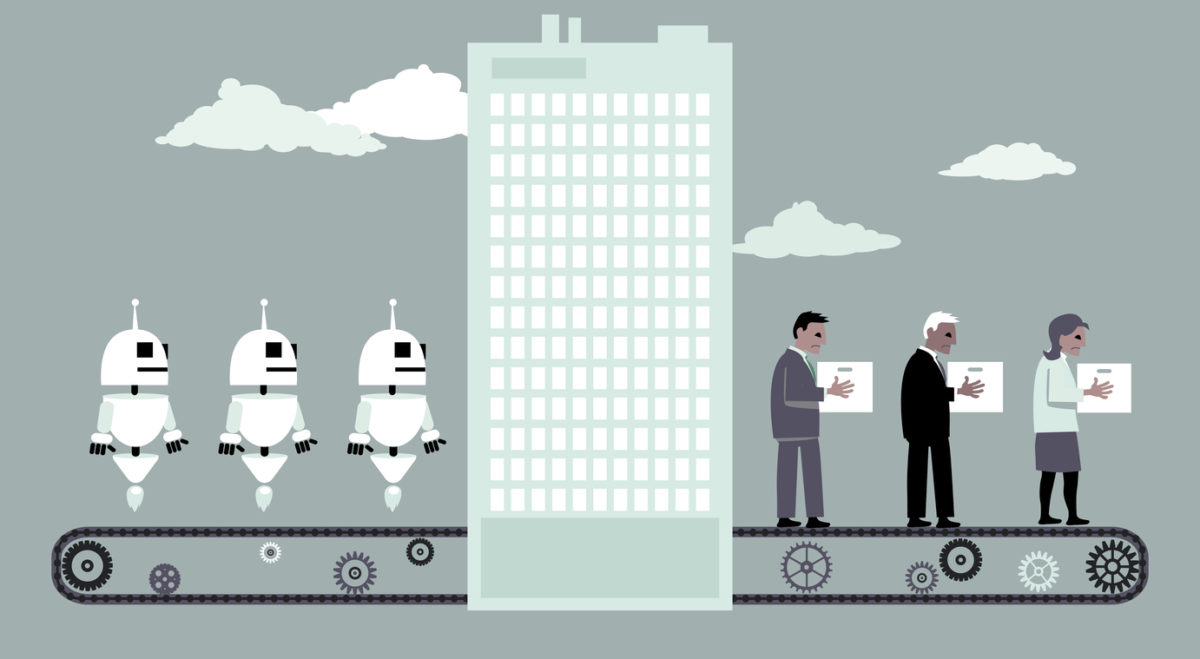
Developments in information technology revolutionize every aspect of our lives. Can you imagine a world where people do not have to go to work?
What if human effort and labour is not needed in the future?
Oxford university economists Dr Carl Frey and Dr Michael Osborne predicted that by 2050 40% of human roles will be taken over by automation . This means that AI will eventually replace humans. As of the remaining people in the future, they will have to perfect their adaptability skills since new technologies are changing the way we work towards more multi componental and changeable tasks. This includes the knowledge people possess (Seager 2016).
In the future telemarketing jobs, tax preparation, legal service assistance, cooking jobs, etc. are very likely to be almost completely replaced by robots. However, job which involve creativity, building complex relationships with people and high unpredictability are going to remain (Mahdawi 2017).
Recently, Bill Gates proposed that companies using AI instead of human efforts should be more heavily taxed in order to slow the pace of automation advances and support other kinds of employment. Gates believes that this will allow the changes that new information technologies are bringing to be handled better. So, for instance if a human worker making 50000$ a year pays taxes on that income, a robot installed on the place of that person should be taxed similarly ( Delaney 2017).
However, wouldn’t taxing AI discourage the development of progressing technologies intending to improve our lives?
We should re-think the changes that are happening and how they will affect us on personal and professional level. Looking far in the future might be a good idea in order for us to be prepared of what is coming and start acquiring new skills and knowledge (Boyer 2017).
The answer to AI taking our jobs might not be taxes but simply training workers to execute the right tasks with the right skills.
After all, we are living in a fast-changing world and it is not surprising to see ex-fast food workers or street cleaners become good coders, for example. Plus, imposing taxes on AI might have a negative effect in many industries where there will be mass off-shore of production and no creation of at-home jobs (Kenny 2017). Do you think in the future there will be no jobs for humans? How can we keep up with the fast-changing information technologies?
References:
Boyer, L. 2017, ‘Should You Be Worried About AI Taking Your Job Away?’, Forbes magazine, Available at: https://www.forbes.com/sites/forbescoachescouncil/2017/07/10/should-you-be-worried-about-ai-taking-your-job-away/#36ff5b548430’, [Last accessed: 9 October 2017].
Delaney, KJ. 2017, ‘The robot that takes your job should pay taxes, says Bill Gates’, Quartz.com, Available at: https://qz.com/911968/bill-gates-the-robot-that-takes-your-job-should-pay-taxes/, [Last accessed: 9 October 2017].
Mahdawi, A. 2017, ‘What jobs will still be around in 20 years? Read this to prepare your future’, The Guardian online magazine, Available at: https://www.theguardian.com/us-news/2017/jun/26/jobs-future-automation-robots-skills-creative-health, [Last accessed: 9 October 2017].
Seager, C. 2016, ‘Will jobs exist in 2050?’, The Guardian online magazine, Available at: https://www.theguardian.com/careers/2016/oct/13/will-jobs-exist-in-2050, [Last accessed: 9 October 2017].
Kenny, D. 2017, ‘Bill Gates is Wrong: the Solution to AI Taking Jobs is Training, Not Taxes’, Wired.com, Available at: https://www.wired.com/2017/04/bill-gates-wrong-solution-ai-taking-jobs-training-not-taxes/, [Last accessed: 9 October 2017].

Hi Iva,
I think this is an interesting and scary question at the same time. From a macroeconomic perspective, job automation will impact both individuals and governments. If what economists have predicted (Dr Carl Frey and Dr Michael Osborne) happens, most governments will (financially speaking) suffer from it. Cash inflow that governments currently benefit would disappear in that case. We can think about income tax that would significantly decrease if many individuals lose their jobs. Public authorities will have to help people financially in their transition period. Moreover, individuals left without a job will contribute less to the economy in their everyday life (e.g. less money spent on car, gas, electronics) that will result in less VAT paid.
One solution could be the one Bill Gates proposed (mentioned in your post) that would prevent losses from income tax and would slow down the job automation process. Other solutions may exist, but in my view AI does not necessarily improve our lives and could cause ‘collateral damage’ to the economy if its development and expansion in the corporate world are not managed properly.
However, job automation does not necessarily mean job destruction. It is true that we are living in a fast-changing world and individuals can get a completely different job, working in a different industry through the access of various training and with the help of advisors. In the modern era, Western cultures have experienced many technological revolutions (e.g. Industrial revolution in the 18th century, Scientific-technical revolution in the 20th century) and most countries still maintain a relatively low unemployment rate. In my opinion, governments should make sure job automation does not happen too fast and provide incentives for companies to re-direct their employees to other tasks in case of mass automation.
To conclude and to answer your last questions, I think there will still be plenty of jobs for humans that robots will not be able to do. Because human labor is vital for both individuals and economies, a significant part of current jobs will be protected and some other will be created. For instance, who would have thought back in the 18th century that some firms now employ hundreds of business model consultants?
Thank you Iva for your acurate and interesting blog post.
There is one part in your blog that graps my attention, which is the part about the fast-food workers or the street cleaners could become good coders. Could you elaborate on that, since if they could be good coders in the future, why wouldn’t they already be now or start learning already?
Furthermore, to answer your question. I do not believe that we will be totally out of jobs. This is mainly due to the fact that machines will be capable of doing a lot, but not everything. For instance, maintenance or control will probably be part of humans jobs descriptions. But overall, Human jobs will definitely change. Eventhough, after conducting a survey, people believe after the adjustments they already have been through they are good to go for a while. In most jobs, the core skill set will be replaced by new ones in 2020. (VanderMey & Rapp, 2017)
Reference:
VanderMey, A., Rapp, N. 2017, Which Jobs Are Getting Automated the Fastest? Retrieved from, http://fortune.com/2017/04/26/technology-automation-changing-jobs-skillsets/
Hi Ellen, thank you for your interest in my post!
The example with the fast-food workers and the street cleaners was not to direct the attention to these jobs in particular but to make a point that low skilled workforce can also acquire more tech and coding skills. In my opinion, currently the self-motivated low skilled workers are actually actively trying to retrain themselves. However, when it comes to people who do not see the benefits of acquiring new knowledge for the future, incentives to learn have to be created. As Martin mentioned below, low skilled workers often do not have access to courses for numerous reasons. That is why partnerships between colleges and employers, tax advantages for companies with training programmes, publically funded learning schemes, etc. have a real potential of incentivizing unmotivated low skilled workers to retrain. #
Hopefully this answers your question :).
Hi Iva. I am quite confident in answering your question: “Do you think in the future there will be no jobs for humans?”, with a no. History has actually showed us that technology creates more jobs than it takes. In 1900 40% of the U.S. labour force worked in agriculture. Today, this number dropped to only 2% (Tyagarajan, 2016). However, this drastic drop has actually saved thousands of people from performing boring, repetitive and dangerous jobs. Moreover, research showed that technology has actually created more jobs than it took over the past 144 years (Tyagarajan, 2016).
I do believe certain jobs will be eliminated, but I also think this will open up new opportunities for new jobs to be created. For example, in order for the new technologies to operate well people are needed to support the systems. In addition, people are needed to train ‘the new workforce’. Furthermore, I believe the challenges on the labour market caused by the introduction of new technologies will make people more creative in looking for new job opportunities. This will push the creation of new jobs.
As long as people are willing to keep developing themselves, allowing them to adapt to changing circumstances, there should be no fair for them to be unemployed. A good dose of curiosity would be very helpful for all of us though…
Tygarajan, T. (2016). Digtization won’t necessarily cut jobs. Fortune. [online] Available at: http://fortune.com/2016/08/17/ai-u-s-workforce/
Highly appreciate that you chose that fascinating topic, Iva!
Primary, a nice website that enables you to calculate the probability that your job will be taken by robots soon: https://willrobotstakemyjob.com/. Based on that, I’m sure that there will be human jobs in the future.
As you mentioned, there are obviously several jobs and job categories that will be replaced by technology. Just imagine the substantial effect of self-driving cars fully implemented in the economy, and the resulting loss of jobs (taxi drivers, bus drivers, truck drivers, delivery drivers etc.). Therefore, it’s crucial that companies and governments strive to prevent the upcoming mass unemployment by retraining their employees. You mentioned that “…it is not surprising to see ex-fast food workers or street cleaners become good coders”. Unfortunately, I think that this example depicts the exception than the rule.
At the beginning of this year, the Economist published a special report on Learning and Earning in which they (among others) critically approach the benefits of Massive Open Online Courses (MOOCs). “For lower-skilled workers of this sort the world of MOOCs, General Assembly, and LinkedIn is a million miles away”. Moreover, “one in five adults, on average, has poor reading and numeracy skills [and one] in four has little or no experience of computers”. Definitely, MOOCs are an excellent opportunity to enable the above mentioned ex-fast food workers to learn new coding skills, but at the end we have to be aware that the people who actually need these additional skills the most to find a new job (and at the end to survive) are not able to access them.
Although we won’t see the full implementation of self-driving technology worldwide in the next 5-10 years, we have to face that this (and other) techs will be implemented in the future massively replacing jobs. Consequently, we need to start now to approach this problem by training the people with crucial skills such as reading, numeracy, and computer skills to enable their survival in the future. But again, we have to keep in mind that people do not like change even when it’s for their own best.
Perhaps, we rather need a domain called https://how-to-survive-when-robots-took-my-job.com 😉
Sources:
https://www.economist.com/news/special-report/21714175-systems-continuous-reskilling-threaten-buttress-inequality-retraining-low-skilled
Interesting post Iva!
Like Brynjolfsson & McAffee (2017), I believe that, while there certainly are jobs that will be disappearing, the management positiont that we are aiming for will proceed to exist. Where robots or other machines take over regular jobs, they create new jobs as well. Think of maintenance, development and more importantly: to decide what the robot or machine should do and to align the company strategy with the development of technology.
The article states: machines will not replace managers, managers who make use of AI will replace managers who don’t. I cannot agree more.