From a historical perspective, it is logical that education in healthcare and thus expertise in surgery has concentrates in few places worldwide. Those with access to high quality education since their childhood are the only ones able to pursue such noble dreams; the art of making fellow humans great again. Well, fellow humans that are close by, unfortunately. For example, in Germany, Italy, Sweden and Finland, there are between 110-115 surgeons per 100,000 people, compared to 0.46 surgeons in Tanzania, or 0.56 in Mozambique (The World Bank, 2019).
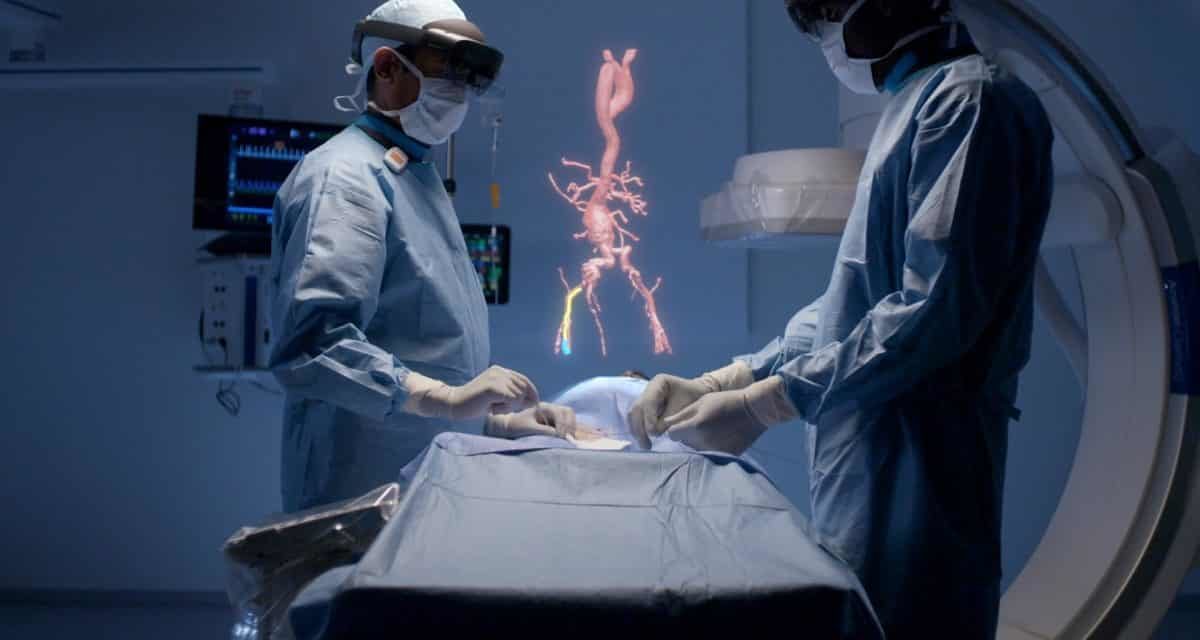
How can we provide better healthcare and treat patients equally worldwide? What role can technology play to redistribute the world’s expertise of surgeons? Augmented reality is making it’s first steps into the healthcare domain. For example, Philips announced a partnership with Microsoft to embed the Hololens 2, an augmented reality device, in their operating rooms (Philips, 2019). Currently experimented with for minimally invasive therapies, but the future could be more promising.
With such technology, an expert surgeon can play a crucial role by assisting remotely during a surgery, being the main guidance for surgeons that are not as experienced. This means that in areas where there is no surgeon at all, this would drastically improve success rate of surgeries without excessive long-term investments in education (and all infrastructure around it). Of course, such devices are super expensive for these areas and therefore not very scalable. In semi-educated areas where there’s few (and not zero) specialized surgeons, there may be situations where there’s a very special patient that none of the surgeons have any experience with. In these rare occasions, having professional guidance remotely could be a life-changer. Or, if the one specialised surgeon in a specific are is unavailable at a crucial moment (whether due to holidays or no night-shift) and there are surgeons in other parts of the world in their working day, and with the right expertise, they could also be a key factor for treating a patient successfully.
With help of a device such as the Hololens 2. This allows treating patients worldwide at a higher success rate. Furthermore, these viewings can be used for educational purposes to educate locally and on the spot. However, serious financial investments have to be made, but I am wondering if it would be a solution compared to building full educational infrastructure. And most importantly, by learning on the job, local expertise can be built so the mechanism is educative by nature.


I found this article very fun to read. I am absolutely convinced that remote surgeries, robot-assisted surgeries and other technologies will contribute to the healthcare of the future. However, I think that there are still a lot of steps before implementing these technologies in poorer countries is useful. Majorly spread diseases (in Africa) like AIDS and Malaria are not operatively cured. And many other diseases are simply caused by bad living circumstances or uneducatedness, like dirty drinking water and poor hygienic standards. I think investing in education and the economies of these poorer countries, enable them to educate themselves, each other and the countries’ next generation. I think it is a step too far as a solution for current healthcare problems in third world countries, but remote surgeries really do have a fantastic potential.
Hey Marc,
interesting read, as this topic is also quite time sensitive. With a difference in healthcare opportunities between industrial and developed countries the need to transfer knowledge in the healthcare industry is highly relevant. I recently stumbled across a video regarding the power of 5G mentioning the firstly remote surgery with the help of 5G in Barcelona. Surgery telementorin is not new to the industry, however the surgery was connected to a 5G connection which allowed commands to arrive in real-time- a huge new step on the way to remotely controlled robot surgery. So this also draws the question whether technological progress can replace full educational infrastructure. In my opinion it can not, as infrastructure itself is a scarce in developed countries and prior to using remote surgery infrastructure should be established, which again drains more funds. Moreover, with surgeons helping other colleagues remotely the scarcity of doctors around the world is still not solved so perhaps and online education platform for surgeons would make a difference – what do you think?