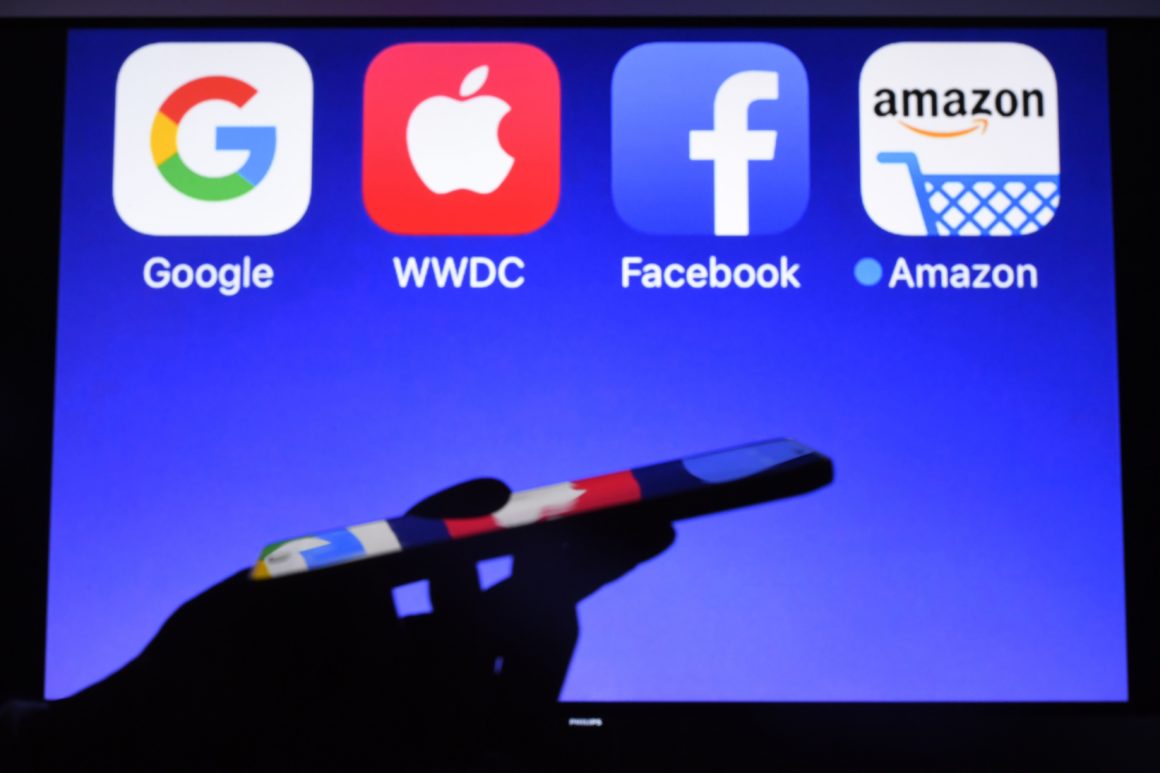
The American house of representatives has concluded that big tech companies such as Facebook, Apple, Google, and Amazon have misused their dominant position on a big scale. Hence, that is the reason that the American commission advocated for the split of Big Tech companies alike. However, what exactly did these tech giants do wrong?
The digital business model of tech giants
With regard to digital business models, the observation can be made that these big tech companies (Apple, Google, Amazon, and Facebook) are ecosystem drivers as they provide a platform to conduct business (Weil & Woerner, 2020). Furthermore, they have complete knowledge about their customer by the amounts of data they generated about their customers. It is interesting to see that certain of these technology companies (such as Amazon) gained significance by disrupting the market while pursuing a long-tail strategy (Hillesund, 2007).
The problem
The commission deems to prove that Google (regarding search engines) and Facebook (concerning Social Media) became monopolists through unauthorized practices. Furthermore, researchers claim that Amazon and Apple have “lasting and significant market power” that they partly forced by locking out competition through their platforms (De Tijd, 2020). The logical consequence is that competitors are discouraged to innovate. Thereafter, the privacy position of consumers is jeopardized by the dominant position of a handful of tech companies. It also becomes more difficult to find truthful news if only a few big companies are the spreaders of it.
Examples of wrongdoings
The report claims that Amazon frequently uses third-party sellers to assist in improving and selling their own products. Apple uses its presiding market position to benefit its own applications and hamper those made by rivals. Facebook preserved its monopoly through a chain of anti-competitive business practices. Specifically, it bought up potential rivals such as Instagram. The report states that Google had demanded smartphone manufacturers using its Android operating system should install Google’s chrome as its standard web browser (www.ft.com, 2020).
It can be concluded that Big tech companies did not always use the right means to obtain their market position. Obviously, the big tech companies have responded in a disapproving manner (RTL Nieuws, 2020). This raises some questions for me to you, the reader.
Do you think the report was fair and just? Do you think it is beneficial to society that these tech companies have so much market power? If sanctions are imposed, do you think these tech companies should be split up or do you think other sanctions must come into place? Which other sanctions should come into place?
—
De Tijd. (2020). Amerikaanse commissie pleit voor opsplitsing Big Tech. [online] Available at: https://www.tijd.be/ondernemen/technologie/amerikaanse-commissie-pleit-voor-opsplitsing-big-tech/10256341.html [Accessed 10 Oct. 2020].
Hillesund, T. (2007). Reading Books in the Digital Age subsequent to Amazon, Google and the long tail. First Monday. [online] Available at: http://hdl.handle.net/11250/184283 [Accessed 10 Oct. 2020].
RTL Nieuws. (2020). Commissie VS wil techreuzen opsplitsen: Big Tech is te machtig. [online] Available at: https://www.rtlnieuws.nl/tech/artikel/5188715/commissie-vs-pleit-voor-opsplitsen-big-tech [Accessed 10 Oct. 2020].
Weil, P. Woerner, S.L. (2015). Thriving in an Increasingly Digital Ecosystem. [online] MIT Sloan Management Review. Available at: http://mitsmr.com/1BkdvAq [Accessed 10 Oct. 2020].
www.ft.com. (2020). Subscribe to read | Financial Times. [online] Available at: https://www.ft.com/content/ccf00858-30a2-49d3-9ae9-7db3f58773b0 [Accessed 10 Oct. 2020].

Hi Thibault,
I would like to compliment you for the enticing discussion points you’re bringing up at the end of your article. In my honest opinion, I think that the White House antitrust committee’s decision to overhaul the big tech’s (Amazon, Apple, Facebook & Google) business practices to stop competition abuse is justifiable. Although these big tech’s services are immens populair and essential to a fast-growing digital economy, these companies have shown unethical practises such as using their platform power to promote their other services and making acquisitions to eliminate potential rivals colonize new markets. The impact of these formed digital monopolies on society is that innovative startups are less likely to succeed and are kept small. Imposed sanctions to split up these tech giants would be the most drastic outcome and should be omitted. One should first increase resources at enforcing existing antitrust rules; tighten up the laws to give the enforcers more teeth; or design entirely new regulatory frameworks with the most powerful digital gatekeepers in mind.
Hey Thibault, interesting post!
I wanted to comment about the idea of breaking these companies up to hinder their current state of monopoly. In my opinion breaking up these huge tech companies would not achieve anything, or anything lasting at least. My reasoning for this is that in the past, breaking up monopolies was successful because of their dependence on business units that were geographically scattered. Therefore, splitting these business units up achieved the desired effect of these companies not being able to immediately regain their dominant position, since they were heavily reliant on various other units which were physically elsewhere.
The issue were huge tech companies like, for example, Facebook, is that even if they were split up in an attempt to impact their monopoly-esque state in the market, the network they exist on is shared and cannot be split up. SO with the network still being the same and still accessible by all, one business unit of the split up Facebook would regain traction and gain a dominant position. Users would be attracted to this one business unit and we would be back to square one.
I do not know what could be a good solution to this issue, but perhaps governments need to take control of the data storage centers of such huge tech companies, but that of course would beg a different question by itself…
Hi there,
Good job on writing the article. In my opinion, high concentrations of power within markets is always a tricky thing to assess.
In my opinion, America’s big technology companies, 2020 has been both very good and bad. The pandemic has played to their strengths, in which millions of consumers have geared up their online shopping, home-entertainment, business and social contact. The ability of these companies to prosper during the lockdown has propelled their market values and market dominance to new highs.
Although, this year also can go in the books in which US legislative actions will put brakes on these types of organizations with the use of regulation. Somewhere this month, a 500 page report from the House of Representatives antitrust subcommittee unfolded that companies like Amazon, Apple, Facebook and Google are wielding monopoly power and that they have abused it. The following years may become a repeat of the full-on regulation of US banks after the 2008 economic crisis, but then for the technology industry. A quote from the report even stated that the big four have gone from “scrappy, underdog start-ups” to the “kinds of monopolies we last saw in the era of oil barons and railroad tycoons”.
Moreover, with the possibility that Joe Biden will become the president elect, higher degrees of regulation are also on the horizon.
Hi there,
Good job on writing the article. In my opinion, high concentrations of power within markets is always a tricky thing to assess.
In my opinion, America’s big technology companies, 2020 has been both very good and bad. The pandemic has played to their strengths, in which millions of consumers have geared up their online shopping, home-entertainment, business and social contact. The ability of these companies to prosper during the lockdown has propelled their market values and market dominance to new highs.
Although, this year also can go in the books in which US legislative actions will put brakes on these types of organizations with the use of regulation. Somewhere this month, a 500 page report from the House of Representatives antitrust subcommittee unfolded that companies like Amazon, Apple, Facebook and Google are wielding monopoly power and that they have abused it. The following years may become a repeat of the full-on regulation of US banks after the 2008 economic crisis, but then for the technology industry. A quote from the report even stated that the big four have gone from “scrappy, underdog start-ups” to the “kinds of monopolies we last saw in the era of oil barons and railroad tycoons”.
Moreover, with the possibility that Joe Biden will become the president elect, higher degrees of regulation are also on the horizon.
Hey Thibault,
Thank you for this interesting post on the developments of the case from the house of representatives against big tech companies. By judging the big tech companies with such a report, I believe the house of representatives missed a vital societal point. It is not that these problems raised out of nowhere. Especially in the United States, the regulations on data protection are at bare minimum. Companies will always try to push the limits on several sensitive subjects of society, like privacy. This is because especially with the intensified competition through digitization, big tech companies are more or less forcing each other to optimize the value of the data and information they “possess” in order to maintain a competitive advantage.
I do agree with the fact that when the grip on the market of these big tech companies becomes too big, it could mean the market structure changes to several monopolies which will hamper innovation because there is no pressure from competitors to improve products and services. Thus, by hampering innovation, society will definitely not be better of by these several big players on the market. Therefore, I do believe the big tech companies should be sanctioned with some constraints on the power they have on the market.
However, rather than punishing the big tech companies for literally doing their job, the house of representatives should have looked at ways on how to protect the consumer. That is, the United States has not a very strict data protection guidelines like we have in Europe through the GDPR. I think splitting up these large tech companies would be a bit excessive as they did not disobey the law. However, the house of representatives should look at strengthening privacy regulations in order to protect the consumer.This will inevitably also hit the smaller companies of course. Therefore, I also suggest that the big tech companies should adhere to more strict market regulations like cartel-forming or prohibition of monopolistic behavior in markets.