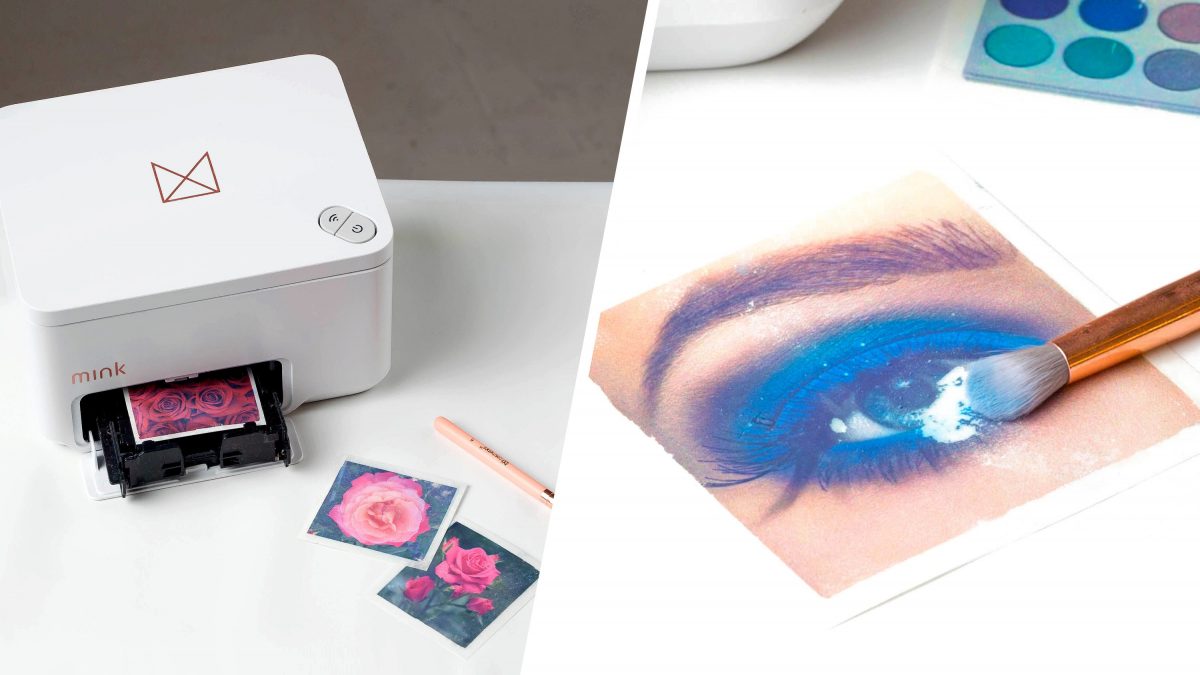
Brands combining beauty and technology have been an increasing occurrence in recent years, with anything from augmented reality apps to try on makeup, to smart devices offering personalized experiences at scale. A company that is jumping on this trend is Mink, which introduced the world’s first-ever 3D portable makeup printer. The concept was first debuted by CEO Grace Choi at the TechCrunch Disrupt Conference back in 2014, and they have since then worked on refining the product for its official release.
So how does the makeup printer actually work? After downloading the Mink app, the user can import any image to print- anything from a screenshot from Instagram, to a Google image, or a selfie from your camera roll. The user then gets to choose between printing the whole image or a specific color featured in the picture. Then you simply have to click ‘send to print’ and within 15 seconds the makeup is printed on a thin sheet of paper and ready to be used. To get a better idea of what this looks like, you can watch the video below:
While the idea of being able to easily print the exact shade of lipstick your favorite celebrity recently wore in a picture is exciting, it still raises some concerns. Firstly, it raises questions about copyright issues and the right to simply duplicate any makeup product at home. Dupes and knockoff products is already a well-known issue in the beauty industry, and enabling people to simply print any makeup they want at home would certainly not help this. However, the quality and ingredients of the product could of course vary significantly as only the color itself is copied. Adding to this, cosmetic chemists have expressed worries about the difficulties in making quality ingredients printable. This does not only concern how well the makeup applies or lasts, but also how you can control the safety of a product and ingredients in an ink cartridge.
I think the idea of 3D printing makeup is really fun and offers great opportunities for creativity as well as offering a more sustainable alternative to the plastic packaging makeup typically comes in. However, the concept will still have to be developed to become widely adopted and I am curious to see how Mink performs when their product finally launches.
References:
Driver, G. (2019, June 19). The Pros And Cons Of 3D Printed Make-Up As It Becomes An At-Home Reality. ELLE. https://www.elle.com/uk/beauty/make-up/a28096868/mink-3d-printed-makeup/
Fasanella, K. (2019, June 18). The Mink, World’s First 3D Makeup Printer, Available for Pre-Order. Allure. https://www.allure.com/story/mink-3d-makeup-printer
Folk, E. (2019, September 23). How 3D Printing is Changing the Cosmetics Industry. 3DPrint.Com | The Voice of 3D Printing / Additive Manufacturing. https://3dprint.com/254128/dhow-3d-printing-is-changing-the-cosmetics-industry/
Restauri, D. (2014, September 11). A Harvard Woman Is Blowing Up The $55 Billion Beauty Industry With 3D Printed Makeup. Forbes. https://www.forbes.com/sites/deniserestauri/2014/06/30/a-harvard-woman-is-blowing-up-the-55-billion-beauty-industry-with-3d-printed-makeup/?sh=21b825617542
Sharkey, L. (2019, June 21). 3D Printing Your Own Makeup Could Be The Future Of Beauty, Thanks To One Woman. Bustle. https://www.bustle.com/p/3d-printing-your-own-makeup-could-be-the-future-of-beauty-thanks-to-one-woman-18135407

Hi Anna, I really liked reading this article. This invention to me is a cookie-cutter example of not letting go of your childlike imagination and actually making it into a (profitable) product. The older we get the more we tend to think in problems rather than letting our imagination run free, which can often be a boundary to our creativity without us knowing it.
Regarding the product itself, I do agree with the cosmetic chemists in the concerns of the quality of the make up from the printer. I have recently seen in a Youtube documentary how much research goes into developing and producing makeup, which is also where the copyright issues come into play. However, I fully agree with you that the Mink printer is a fun way to experiment with make up. I think it will save a lot of disappointment of people that order certain make up online and are not satisfied with the color or quality. I think many people can relate to some real life disappointment from an online order.
From a social media and information standpoint, it is interesting to see that certain looks will become instantly attainable, by allowing users to print exact colors as they have seen online. I am curious as to how the final product will work and how this technology could possibly have other applications in the future.
Hi Anna! Such a nice blogpost. I find it very interesting that you found something that is related to make up and digitalization! Crazy to think that this might be the way to go in a few years.
I wonder how this would find its way into the everyday life. Maybe people won’t need to go to the drugstore anymore to buy make up, but print it themselves at home?
I really like it that you have added a video to your blogpost which gives a really great understanding of how the 3D printer works. I was first wondering how they would print the make up, but it looks so fun to take it of the printed element. Also nice that you add some constraints of the printer like copy rights. Although I wonder how good the pigmentation and overall quality is of the printed make up. Maybe a solution would be that high quality make up brands start selling their substances, for instance eyeshadow powder, to which you can add a color to at home. In this way they still maintain their well known quality and let people experiment.
Very good find of topic! I very much enjoyed reading it.
Hi Anna, really cool article! Very different perspective and a cool initiative. You mention sustainability in your article, but I was wondering how sustainable you think this idea is? You mention the decrease of usage of plastics, however a printer is also not very sustainable I think? Or do they have a solution for this? Very curious to know what you think!