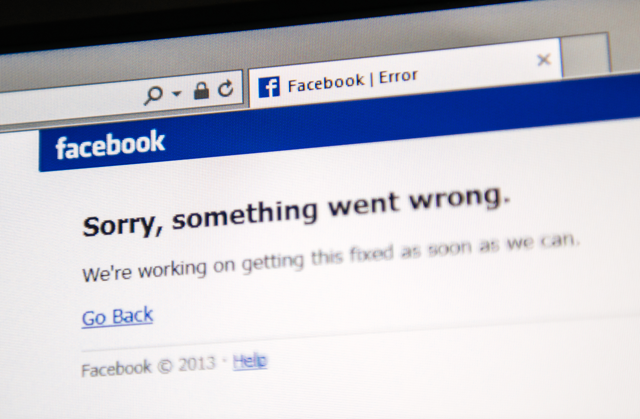
On October fourth the Facebook network experienced a six-hour long outage on its main social media platform and its subsidiaries, such as Whatsapp, Messenger and Instagram. This global outage, most likely caused by a human error had a substantial impact on its users and other online actors (Heah, 2021). Instances like these present us with a harsh truth: daily lives are largely influenced by the power of the Facebook network.
Facebook and Instagram over the years have opened up new doors for small business owners and in turn offered them a platform to elevate their business to a new level. The other side of the coin is that this group was impacted most severely by the outage, since they rely on the platforms to run their businesses. On the other hand, other social networking sites experienced a surge in their traffic as a result of this outage (Martinho, 2021).
It is no secret that Facebook’s power stretches to great lengths, but users usually end up accepting this as a byproduct in the trade-off between convenience and giving up part of their autonomy. Previous employee Frances Haugan brought to light that Facebook has often made choices where profits prevailed over public health and safety (The Guardian, 2021).
While Facebook has often been accused of monopolizing the industry in which it operates, it does not fit the text-book definition of a monopoly. The US Federal Trade Commission must meet a two-part test in its antitrust case against Facebook, to prove their monopoly power. They must first identify the industry correctly and consecutively prove that Facebook dominates 60% of this industry (Liss, 2021). However, this two-part test may not be most suitable for establishing whether a monopoly exists in a social networking and messaging industry, since it completely neglects a crucial contributor to Facebook’s power: network effects.
A network effect is a phenomenon whereby the value of a good or service is embedded in and increased by the number of users (Banton, 2021). This exactly highlights why users have become growingly dependent on Facebook and explains why they often settle for giving up part of their autonomy. This factor should not be brushed off too easily by the court when ruling in the case of Facebook and the FTC.
References
Banton, C. (2021). Understanding the Network Effect. [online] Investopedia.com. Available at: https://www.investopedia.com/terms/n/network-effect.asp#:~:text=The%20network%20effect%20is%20a,of%20a%20good%20or%20service.&text=Initially%2C%20there%20were%20few%20users,military%20and%20some%20research%20scientists..
Heah, A. (2021). Facebook, WhatsApp & Instagram Outage Could’ve Been Due To Human Error. [online] designtaxi.com. Available at: https://designtaxi.com/news/416048/Facebook-WhatsApp-Instagram-Outage-Could-ve-Been-Due-To-Human-Error/.
Liss, D. (2021). Today’s real story: The Facebook monopoly. [online] Techcrunch.com. Available at: https://techcrunch.com/2021/08/19/todays-real-story-the-facebook-monopoly/.
Martinho, C. (2021). What happened on the Internet during the Facebook outage. [online] Cloudflare.com. Available at: https://blog.cloudflare.com/during-the-facebook-outage/.
the Guardian. (2021). Facebook putting profit before public good, says whistleblower Frances Haugen. [online] Available at: https://www.theguardian.com/technology/2021/oct/03/former-facebook-employee-frances-haugen-identifies-herself-as-whistleblower.

Hello Jamila,
Very interesting topic! I can see the importance of talking about this problem, which is why I will share my thoughts in this comment:
The recent outage, was a wake up call for me. I was working on a group assignment and communication with my teammates became more difficult. Luckily the problem was solved relatively quickly. However, this did leave me with a question in my mind: How are we as consumers responsible for this problem?
This is where the network effects come into view. Network effects are not only valuable to the companies, but ofcourse also for us. Why choose a platform to communicate if there are less people to communicate with? This allowed some platforms to become extremely big and powerfull, with Facebook as the main player.
What I am trying to say is that we as consumers are, in a way, responsible for this dependency. But what is the way out? Should Facebook be broken up? I think this is a interesting topic to keep in our minds and see how it will evolve in the future.
Hi Sten, thank you so much for your comment and interesting view. The questions you raise are indeed quite hard to answer, since I don’t think any of us know how we can limit this dependency and still be a social player in society without any communicative setbacks. I don’t have a clear answer for you either, however I do think that being aware of this is the first step. Another step we could take is to not put all our ‘network’ eggs in one basket. As we’ve seen from the recent outage, we rely intensively on a single Network for various purposes. Looking back at the example of small businesses, a small business owner could make sure that they gain exposure on other media outlets as well, such as TikTok and Snapchat (owned by a different network), rather than only Instagram and Facebook. They could also make sure that orders are placed through a different channel by not accepting orders via Instagram direct message. In my eyes, this can decrease the dependency on a single platform, while it is of course very impossible to eliminate it entirely.