OpenAI’s ChatGPT has undoubtedly garnered massive media attention through its intuitive user experience and wide application potential in various business and personal contexts. When first testing the technology, users are often impressed by its ability to swiftly and accurately respond to a wide array of prompts. Due to the comparably lower level of restrictions on responses, the generative AI model is able to generate responses that go far beyond what is verbatim stated on websites (Roose, 2023). However, after many months of personally utilizing the AI, I cannot seem to question whether it is capable of expressing creativity in its purest sense.
So I ran an informal test to examine how well the algorithm can brainstorm new business names for a hypothetical digital marketing agency. I observed that ChatGPT often produced rather generic, repetitive and occasionally nonsensical suggestions. When given the following prompt; “Be super creative and think of 10 name suggestions for a digital marketing agency”, ChatGPT gave the following suggestions:

From the responses, it is clear the algorithm interprets rather simple literary techniques such as alliteration (repetition of the first consonant letter/sound (Merriam-webster, 2018)) as “creative”. When asked to be more innovative, the algorithm simply produced alterations of the previously suggested names:
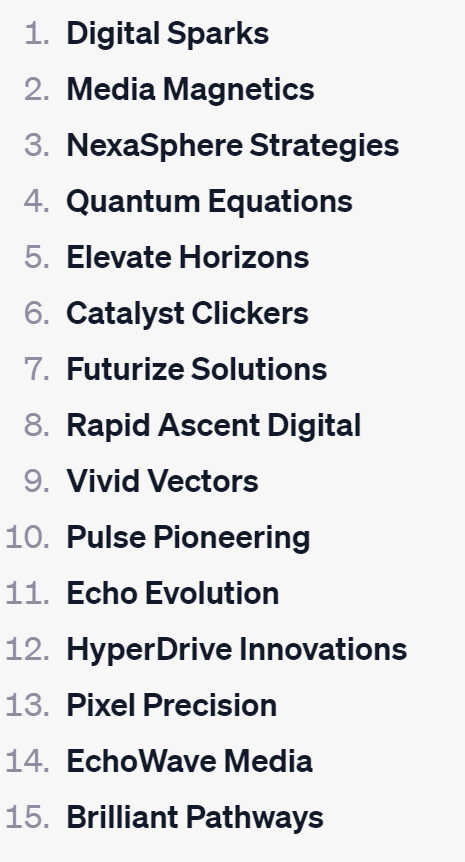
Regardless of the subjective appeal of these names, the suggestions from the subsequent response are highly similar to those given initially. Moreover, the revised response is not completely free of alliteration.
It could be argued that this is because creativity, in its purest sense, transcends the capability of today’s AI models. True creativity can be defined as going beyond what we know and generating new ideas (Kupers et al., 2018). Unlike current machine learning models, humans have the capacity to draw inspiration from numerous sources and make unique subjective interpretations, which aids in generating new connections that have not been made before (Kupers et al., 2018) . By the same definition, usefulness and appropriateness are also imperative facets of creativity (Kupers et al., 2018). In my opinion, ChatGPT also did not live up to its creative reputation in this capacity, as I found the names to be rather generic and obvious.
Of course, this blog post only features a singular isolated example, using two prompts, in the context of business name generation. Therefore, no generalizations can be made. However, it does become clearer that ChatGPT is not, in any way, a silver bullet for all use-cases. Indeed, the algorithm can prove highly useful in specific contexts, however, true creativity is still the missing X-factor. Although ChatGPT can appear to mimic this ability, I would argue that it does not, and possibly never will, embody the creative ability that humans possess.
References:
Kupers, E., Van Dijk, M., & Lehmann-Wermser, A. (2018). Creativity in the Here and Now: A Generic, Micro-Developmental Measure of Creativity. Frontiers in Psychology, 9. https://doi.org/10.3389/fpsyg.2018.02095
Merriam-webster. (2018). Definition of ALLITERATION. Merriam-Webster.com. https://www.merriam-webster.com/dictionary/alliteration
Roose, K. (2023, February 3). How ChatGPT Kicked Off an A.I. Arms Race. The New York Times. https://www.nytimes.com/2023/02/03/technology/chatgpt-openai-artificial-intelligence.html

Hi Anthony,
Thank you for your blog post and your light on ChatGPT’s creative boundaries. Surprisingly enough, I am starting a business and I also asked ChatGPT for inspiration on company names. The results were the same as in your post. I even tried variations with character limits, word limits, no repetitive words, etc., but the results were the same as you stated.
Then I started thinking about how creative an AI application could be that only uses existing data based on current (up to 2021) information. Is it realistic for people to ask ChatGPT to come up with creative, non-existent answers and suggestions? If it only uses existing information, will something ever be considered truly creative? Like you stated, creativity entails going beyond what we know and generating new ideas. Is that then even a possibility?
I know you only mentioned business names as an example, but still, since ChatGPT is only updated until September 2021, we cannot expect and rely on it to provide us with correct information. Furthermore, ChatGPT will also not be able to assess the creativeness of an idea or name since the system is not up-to-date. It cannot evaluate creativeness if it is not aware of all the existing and relevant information.