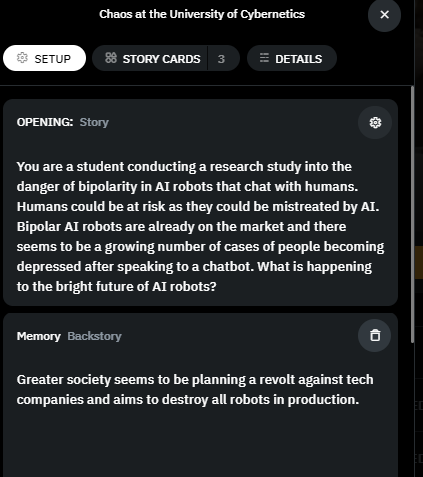
Whilst browsing online for innovative generative AI (GenAI) tools, I stumbled across the video game site AI Dungeon that utilizes GenAI to simulate single and multiplayer text-based adventure scenarios. I started by looking at the features and layout of the website. After being directed to the site, I was able to view community favourites, timeless classics made by other users and recently added scenarios from top creators. There are two main sections on the page once you log in, namely the home page and the discover page, where ‘scenarios, worlds and adventures’ are displayed. For clarification purposes of the different constructions, a scenario is a simple template for starting a new ‘adventure’ that can be held privately or shared online, an adventure being an individual playthrough of AI Dungeon. I decided to create my own ‘scenario’, essentially a story mould that other AI Dungeon users could play and alter to form their own adventure on the platform. The first decision I had to make was choosing a template for my scenario that would determine the ‘author’s note’, in specific the writing style and theme that the AI would try adhere to in its generative piece. After this the setup page was shown where I was given options for prompting the start of the story, the backstory, banned words (words to avoid), third person addition etc. This is shown in the image presented below.
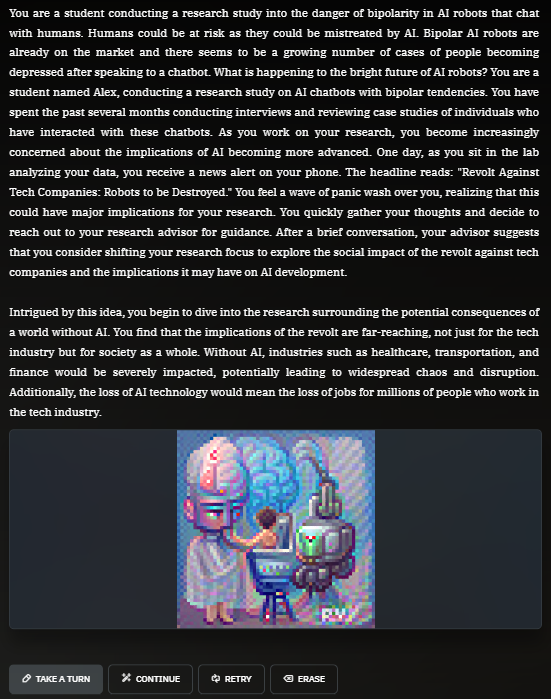
Onto the interesting part of the automated story-telling, the technology generated the start of a story based on my inputs and handed me several options after this to foster user-platform interaction. The platform gave me options along the way to jump in, continue the story, retry the AI story generation and erase parts of the story. The platform makes clear use of large language models (LLM) to generate original content through performing a variety of natural language processing tasks (NLP) tasks (Chen et al., 2021). In fact, the platform uses Griffin, a 6 billion parameter GPT-J model developed by EleutherAI (AI Dungeon, n.d.). Below is an image showing what came out of the generation, interestingly a lot of questions and direct speech are used to maximize the level of interaction between the user and the platform. Users even have the option to generate an image which in this case was not very representative of the story in my point of view. However, the LLMs used are subject to some threats to its users which need to be mitigated, namely data privacy violations, algorithmic bias and misuse (Rosenauer & Sahin, n.d.). This is something that regulatory frameworks need to address in the near future. But that discussion is for another time, all in all, a quite fun experience trying to generate a story using a limited number of inputs!
Sources:
Chen, M., Tworek, J., Jun, H., Yuan, Q., Pinto, H. P. D. O., Kaplan, J., … & Zaremba, W. (2021). Evaluating large language models trained on code. arXiv preprint arXiv:2107.03374.
Rosenauer, P., & Sahin, F. (n.d.). Navigating the risks: Harnessing AI and large language models responsibly in business. PwC. https://www.pwc.ch/en/insights/regulation/AI-and-large-language-models-in-business.html
What are the different AI language models in AI Dungeon? (n.d.). What Are the Different AI Language Models in AI Dungeon? https://help.aidungeon.com/faq/what-are-the-different-ai-language-models

Thanks for sharing this valuable insight. I myself was not familiar with the existence of this AI tool. The clear examples and screenshots you have included in the above article make it easier to use the tool’s function. Impressive to see also that the tool is able to generate not only text, but also images. So I definitely think this tool is a good tool for copywriters as well as storytellers themselves. Perhaps this tool could also be interesting for companies to apply within their marketing or sales.
However, I personally wonder whether the possibilities offered by this tool could not also be offered by Chat GPT, and whether they might not be qualitatively better depending on the prompt? After all, when I look at the response to the prompt in the text, this is given a rather enumerative answer instead of a more human story. I would therefore be very interested in a follow-up post with perhaps a comparison between such software and its applicability within various sectors. All in all, very interesting!