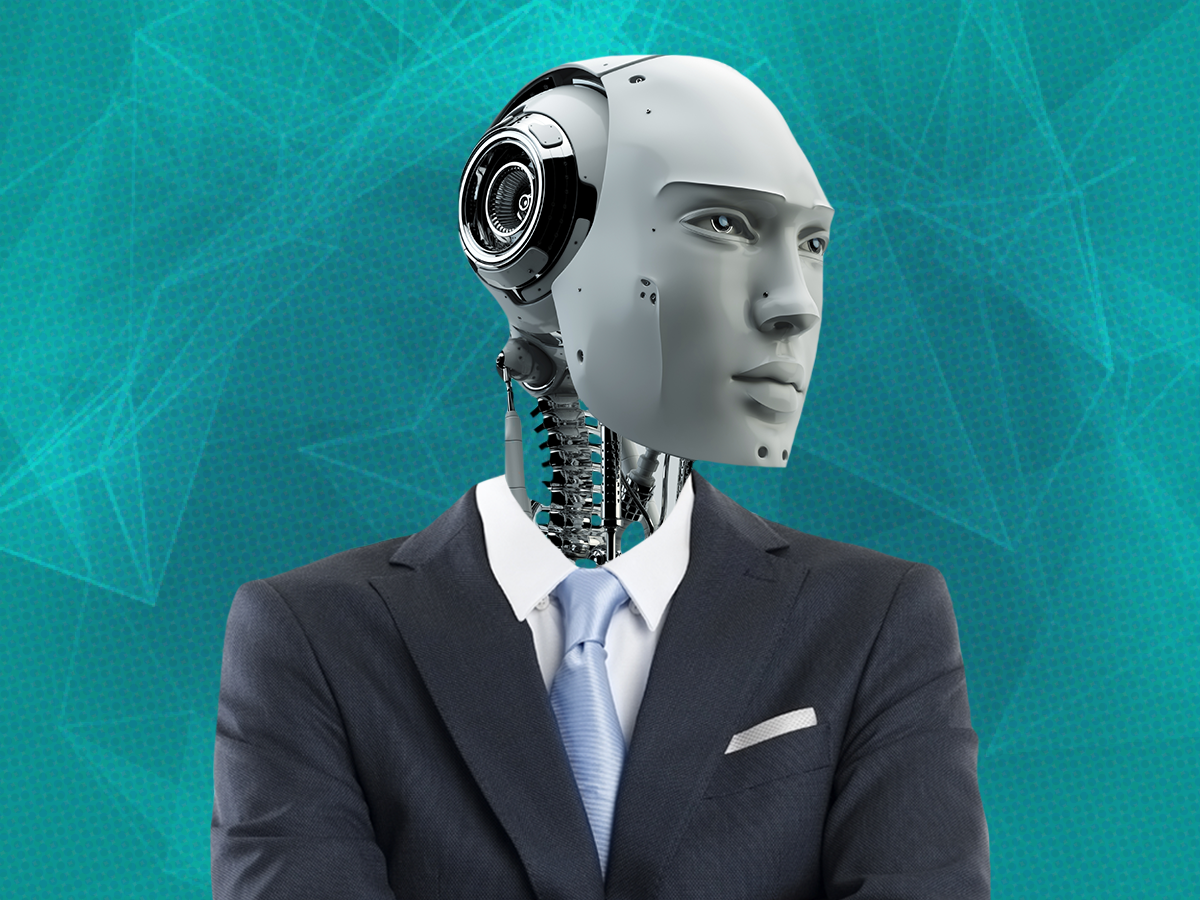
The practice of Artificial Intelligence (AI) is visible all over the world. From petrol stations that are using Big Data in price-setting in order to gain competitive advantages to evolving techniques in stem cell therapy, the opportunities of machine learning seem endlessly.
Have you already heard of Ross? Well, it’s the lawyer’s new colleague that can do anything except fetching them coffee. This piece of AI software uses IBM Watson’s supercomputing power to crunch mountains of Big Data and learns itself over time. When a lawyer asks Ross legal questions, it will give answers with relevant laws and jurisdiction. The possibly best part of Ross is that lawyers can scale their abilities and work more efficient which makes law firms able to charge lower fees. With almost 80% of Americans who can’t afford a lawyer, this big pool can be served with the implementation of Ross in law firms. (Businessinsider, 2017).
The question if lawyers can be replaced by robots was already answered in the early ‘90s by Jaap van den Herik, professor Information Technology at the University of Leiden. He stated that computers can judge certain parts of justice because it’s a specialised task and computers master specialised tasks. His ideas were recently supported by Dana Remus, professor at the North Carolina School of Law, and MIT-economist Frank Levy who published an article about the replacement of lawyers. They concluded that robots are able to ‘sort’ and ‘reason’ far more efficient than humans can (Mols, 2017).
The main obstacle of using current technology as full-fledged lawyers, is that it’s very complex to automate two aspects of lawyers’ work (context and emotion). Lawyers must take all possible circumstances into account when making judgements. With the missing of those abilities in AI software, it’s not yet possible to replace lawyers by robots.
But what about the future? With Facebook shutting down their robots after they invent their own language, nothing seems impossible for machine learning (Griffin, 2017). Not even being a judge.
Bao Pham
415129
References
Griffin, A. 2017. Facebook’s AI robots shut down after they start talking to each other in their own language. Retrieved from: http://www.independent.co.uk/life-style/gadgets-and-tech/news/facebook-artificial-intelligence-ai-chatbot-new-language-research-openai-google-a7869706.html
Mols, B. 2017. Kunnen robots rechtspreken? Retrieved from: https://dekennisvannu.nl/site/artikel/Kunnen-robots-rechtspreken/8182
Weller, C. 2017. The world’s first artificially intelligent lawyer was just hired at a law firm. Retrieved from: http://www.businessinsider.com/the-worlds-first-artificially-intelligent-lawyer-gets-hired-2016-5?international=true&r=US&IR=T

Hi Bao, thank you for this very interesting read. I would love to share my thoughts on the topic, especially on the debate of efficient reasoning vs. emotion and context. I believe that at this moment, it can be very well possible to use robotic judges in cases where all circumstances are straightforward and ‘according to the book’. In these situations, it would make very much sense to replace human judges by robotic ones, in order to save time and costs. A practice with the similar goal of taking workload off judges’ backs and saving trial time and costs, has actually already been in operation in the Netherlands for several years. In certain cases (mostly small, straightforward ones), suspects get their sentence presented to them directly by the prosecutor and not by a judge (Novum, 2014). Therefore, I definitely believe robotic judges could be used in similar situations to these in order to make the trial more efficient.
However, for cases where a lot of unusual circumstances need to be taken into account, robotic judges will not be applicable yet. As you mentioned already, context and emotion is highly important in these situations and these are 2 elements that current robotics do not fully possess yet. I do believe that this will soon change though as robotics are learning to recognize emotions better and better (Krywko, 2016). We’ll have to see what the future holds.
Sources used:
Krywko, J. (2016). Scientists believe they’ve nailed the combination that could help robots feel love. Retrieved October 10, 2017, from https://qz.com/838420/scientists-built-a-robot-that-feels-emotion-and-can-understand-if-you-love-it-or-not/.
Novum. (2014). Meer strafzaken zonder rechter afgehandeld. Retrieved October 10, 2017, from https://www.nu.nl/binnenland/3702421/meer-strafzaken-zonder-rechter-afgehandeld.html.
Hi Bao! Interesting post! I agree with the fact that in the future a lot of jobs will be replaced by technology, and it is happening fast. However, I believe that it is mainly for jobs that are routine- and process based. I find it yet hard to believe that jobs such as lawyers and judges will be replaced by artificial intelligence technology. These kinds of jobs, as you’ve mentioned, require human reasoning and thinking, something I don’t think machines are able to learn. Machines are able to learn from past situations and through data analytics a lot of accurate, fast decisions can be made. However, lawyers and judges deal with a lot of novel cases in which I believe the human factor is important and in which machinery cannot make the right decision.
Interesting post Bao! I completely agree with you that Artificial Intelligence seems inevitable in legal services. Since we are dealing with people’s lifes in the legal sector, it is of great importance that implementation of the law will be executed with high quality. Using Artificial Intelligence enables automating expertise, legal research and contract analytics, which makes the legal procedure more efficient and accurate (Ambrogi, R. 2017). Being assisted by a robot will decrease the possibility of the person practicing law making errors and increase the completeness of their knowledge. This will save time and money and enables the lawyer to help his/her client better and cheaper. However, I think AI will not replace lawyers and judges, but assist them. Robots are (currently) not able to judge the emotional aspects of law, they cannot judge legal terms such as ‘reasonably’, ‘circumstances’ and ‘balancing of interests’ (Vrugt, N. 2016). A robot will be a great colleague, but not a lawyer.
However, do you think that small legal firms will be able to compete with big firms in the future? Smaller firms probably have little resources to invest in artificial intelligence. The work still needs to be done by humans, which makes their service more expensive than when robots are being used. Do you think judges of small law firms will be obviate due to artificial intelligence?
References:
Ambrogi, R., Wright, P. and Reuters, T. (2017). This Week In Legal Tech: Book Review Of ‘Robots In Law’. [online] Above the Law. Available at: https://abovethelaw.com/2017/03/this-week-in-legal-tech-book-review-of-robots-in-law/ [Accessed 10 Oct. 2017].
LAWFOX. (2017). Is de robot de advocaat van de toekomst? – LAWFOX. [online] Available at: https://www.lawfox.nl/blog/is-robot-advocaat-toekomst/ [Accessed 10 Oct. 2017].