How VR will shift our work routine
The COVID-19 pandemic caused a widespread shift in work routines from physical spaces to digital remote spaces. While this undoubtedly mitigated the spread of the virus, it also unexpectedly increased employee productivity, according to research (Natalia Emanuel & Emma Harrington, 2020). This effect came mostly from employees turning physical commuting time into fruitful working time at home. Now that the pandemic-mitigation measures have been (nearly) ultimately lifted, organizations are carefully evaluating their next steps ˗ stay fully online, implement a hybrid working model or completely return to the physical workplace. While the positive effects on productivity might suggest that staying online is the way to go, organizations fear that the current digital tools that facilitate such an approach do not provide the employee with an authentic connection to their workmates. However, the rapid development of Virtual Reality (VR) might be a solution to this dilemma.
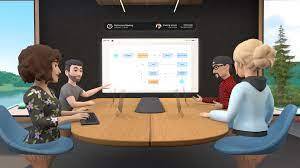
The past few years have been the bottom line for an explosion in mainstream adoption of VR technology, which has been boosted by the recent hype that the Metaverse has caused. Accordingly, organizations look upon the developments of VR favourably. In essence, the implementation of VR technology as an enabler of remote communication would allow the creation of digital immersive workspaces, replicating the physical office in the virtual world. This could make employees feel as if they were in the same location as their teammates and grasp the workplace experience, while still enjoying all the features of digital collaboration (Murray, 2022). Such a space would work as a creation and collaboration platform where the possibilities are infinite from deeply interactive group meetings to real-time product prototyping and co-edition. Additionally, the immersive nature of VR would make workers perceptually ‘leave’ their homes and ‘enter’ the workplace without factually leaving their houses.
As this possibility gains momentum, several tech organizations have taken the first steps by developing promising virtual workspace VR platforms. Meta seems to be the one leading the race with the development of Infinite Office, a digital collaboration platform meant to replicate the physical office in the Metaverse. This space allows the employee to define the boundaries of their virtual office through a complete customization and availability of a wide range of tools that can improve their output and productivity (Chakraborty, 2022).
The implementation of such technology within the workplace is still relatively far considering several potential drawbacks that developers and organizations must carefully evaluate. Substantially, business data privacy continues to be a great concern for organizations, which must ensure the digitalization of their operations does not compromise their confidentiality. Additionally, employee mental health is a delicate issue to be assessed in this regard. A fundamental replacement of physical connections between the workforce might undermine the value obtained from real-world interactions between employees (Giusino & Toscano, 2021). But if this new virtual world is to arrive, organizations will have to cautiously adapt to this revolution and try to create a win-win situation between them and their employees.
References
Chakraborty, K. (2022, August 23). The Future of Remote Work: 7 Technologies to Watch. Techopedia.com. Retrieved October 10, 2022, from https://www.techopedia.com/the-future-of-remote-work-7-technologies-to-watch/2/34559
Giusino, D., Bowman, N., & Toscano, F. (2021, July 28). Work From Home (WFH) During COVID-19: Is Virtual Reality (VR) a New Solution to New Problems? Journal of Occupational &Amp; Environmental Medicine, 63(10), e755–e756. https://doi.org/10.1097/jom.0000000000002339
Murray, A. (2022, April 4). Inside an “infinite” workspace: What it’s like to do your job completely in VR. ZDNET. Retrieved October 10, 2022, from https://www.zdnet.com/article/inside-an-infinite-workspace-what-its-like-to-do-your-job-completely-in-vr/
Natalia Emanuel & Emma Harrington. (2020b, November 16). “Working” Remotely? Selection, Treatment, And the Market Provision of Remote Work. Harvard University. Retrieved October 10, 2022, from https://scholar.harvard.edu/files/eharrington/files/harrington_jmp_working_remotely.pdf

Hi Sergio! Thank you for the interesting story. Well-written and explained! It is very relevant topic nowadays and I am also curious to see how organizations will balance the “online” and “physical” ways of working. I have heard about Infinite Office as well and it looked great! Nonetheless, it only works well when there are no lags in the system and I am personally not a fan of switching towards this way of working online fully. Looking at my current work, which is at quite a rigid firm, I cannot imagine all my senior colleagues adapting to Infinite Office (considering how much they already struggle with Teams and Zoom currently). Besides, I like the face to face contact of physical meetings and think they are ideal for a quick “catch up” or full brainstorm session. Still, I believe the hybrid way of working is the best and hopefully, organizations have no other choice than to adapt to this as this has also become the “new normal”. Curious to hear what you consider the best way of working!