My role and contribution
We built a swim-technique AI for triathletes where users upload videos, and the AI finds technique faults and suggests drills. I swam competitively in the past, also did some triathlons, and saw many triathletes struggling with their swimming technique, so I had a personal interest. In our team, I made the problem and opportunity slides and built the prototype.
Key decisions
The first decision was about the idea itself, which we made badly. We did not agree on criteria, but the same points kept coming back, like that the solution should use AI, come with a working prototype, be something new, should be D2C and be usable in real life. From my perspective the focus on AI mostly came from the assignment description, which pushed us in that direction. The general issue with that was that we started from the technology before we identified a problem.
We had multiple ideas that used AI as a disruptive technology, such as a legal AI, which failed because we could not be sure an AI that assesses compliance can be compliant. An AI for pen testing failed because of hallucination, and AI commentary failed because it was not new. As AR solutions would not have given us a working prototype, we killed an idea about AR glasses for barbers. In the end, we stuck to the swim-technique AI. I also had some doubts about that, but more on that later.
Iterations
As my contribution was mainly about the prototype, my most interesting iterations happened during development. I wanted the video analysis to actually work, as all of my previously developed prototypes were scripted.
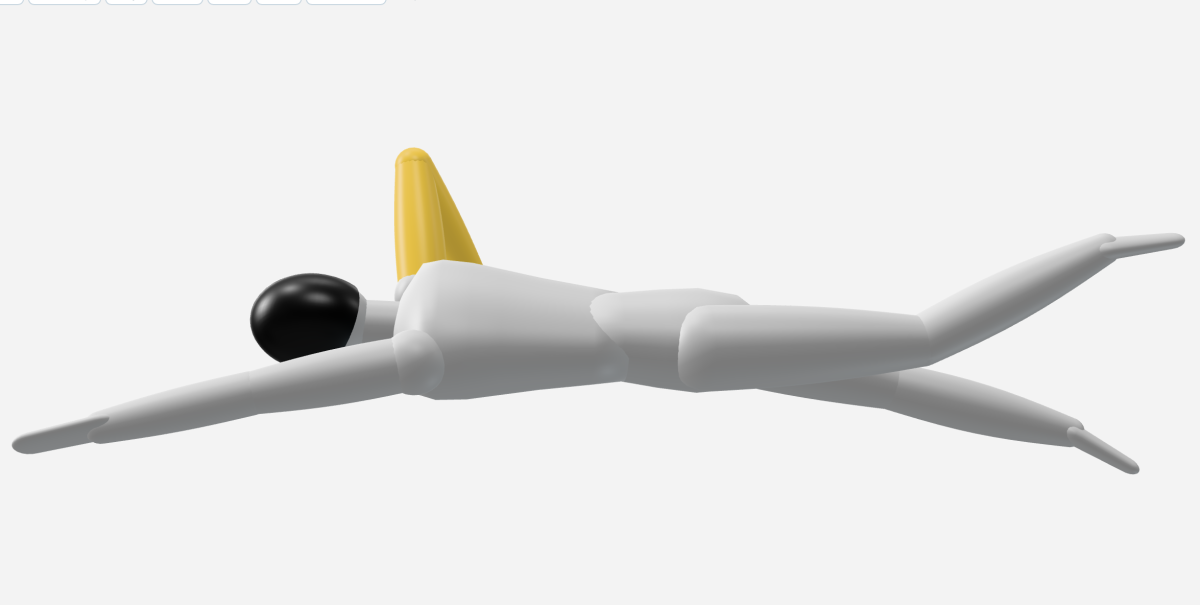
I used a familiar setup from my previous vibe-coding experience. I coded with Claude Code, used the React Native framework and ran it in the iOS simulator on my local machine. I furthermore scraped 80 drills from a public website, which was my first time using a scraping tool. In the next step, I connected it to Gemini’s public API for the analysis. Then, I used Gemini to assess body parts, like the elbow or shoulder, the angles between them, and the waterline. I also explained what good technique looks like, so that my prototype compared it to an elite reference instead of judging. Lastly, I built the 3D mannequin which shows each drill, first with an AI tool for 3D mannequins, later with Claude.
Another iteration happened late in the project and was about the value capture mechanism itself because the AI could be the entry point to a coaching platform, as some users may want to talk to real coaches in the future again.
What went well, surprised me and failed
While it dropped the connection often, Gemini’s API worked generally well and found body parts reliably, but at first it did not assess angles, so the app could not suggest drills. On a side view video, it drew one straight waterline, which was not detailed enough, since waves and the body bend the water, and even after the fix, it stayed weak on the whole-body position. It was also too kind: I uploaded footage of a swimmer whom Gemini called elite, but whom I would call decent. For the mannequin, I first tried an AI tool, built specifically for 3D mannequins. It failed completely, as it understood “flutter kick” in my instruction as a boxing kick, so it showed a fighter instead of a swimmer. Claude instead created the swimmer very fast, so I expected little work. Then the classic Pareto principle hit. Due to some incorrect movement patterns, the last 20% of the mannequin development took very long.
The tests went well, for which we used different swimming videos and the prototype detected the faults. In the end, I was surprised by how unreliable the AI was, but I still feel that the prototype was successful, even though it was not good enough to go live.
How feedback and evidence changed the work
Closer to the presentation, we knew how our prototype worked, but we still wanted a valid concept for a production-ready product. I found out about human pose estimation and a study on swimmers filmed underwater (Coifman et al., 2026). It showed that human-pose-estimation models trained on swimmers reached very high precision in the estimation of body parts, while the same kind of model without specific training barely worked. It did not change the work as such, but it changed our argumentation. We wanted a realistic argument and did not want to just assume that AI would be able to do it. The study gave us a true academic basis that supported the technical feasibility of going live, but it also showed me that a working tool needs a swim-trained pose model and a second agent that judges and interprets the results.
What I learned from collaboration
In the collaboration I felt that we should have used a more structured approach to assess the ideas. Each of us could have suggested some ideas for the project, and we could then have clustered them. Instead, the process was a bit uncoordinated, and in the end, I felt we decided on an idea half because of frustration, as we were tired of discussing back and forth. I had the feeling that the group was generally happy with the idea itself, but a more structured process might have found a more impactful idea than a niche one, which is generally okay, though. Also, as the idea emerged partly from my personal interest, this does not automatically make it a good business idea.
Lastly, our time management could have been better, because we ended up under time pressure close to the deadline, as we were changing some of our arguments.
How my understanding of AI and strategy changed
AI may be stronger on very complex tasks, but in my experience, it still follows the 80/20 principle and still hallucinates a bit. Either Claude sometimes did not understand what I meant, or I was not able to express myself well enough. For both, additional context and reference pictures helped. On strategy, I used to see the AI as the product. Building the prototype changed that: with vibe coding and a free API, a first working version took me one day. If I can do that, so can any competitor, which we also named as a risk in our presentation. This aligns with Barney and Reeves (2024), who argue that AI alone does not create a sustainable advantage but can increase the advantages a company already has. The advantage for us is the training data and the context.
Summing up, my example scares me a bit, as everyone can now build and publish software. I feel data privacy and security are at risk, because even I did not know exactly what was going on in my app or whether it was secure.
References
Barney, J. B., & Reeves, M. (2024). AI won’t give you a new sustainable advantage. Harvard Business Review, 102(5), 72–79.
Coifman, I., Hakim, M., Weiss, G., & Riemer, R. (2026). Human pose estimation for automated biomechanical swimming analysis. Sports Biomechanics. Advance online publication. https://doi.org/10.1080/14763141.2026.2715647
