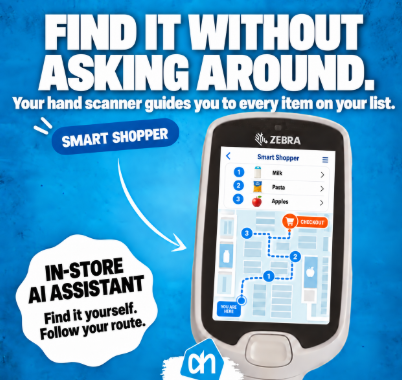
Throughout this project, my team and I developed the concept of the AH Smart Shopper, a digital feature designed to further digitalise the customer journey at Albert Heijn (AH). The concept aimed to connect AH’s existing digital app, handscanner ecosystem, and real-time store data to guide customers through their shopping experience. In particular, it would help customers find suitable alternatives when products were out of stock or when dietary restrictions limited their choices.
My main contribution focused on the business model, economic viability, and potential revenue streams, particularly through the development of a subscription model and versioning strategy. However, my involvement extended beyond the financial aspects, as I also contributed to discussions about value creation, value delivery, and value capture. This helped me understand how these elements needed to work together to create a commercially viable proposition.
When developing the subscription model, I opted for a versioning strategy based on AH’s existing digital ecosystem and customer base. My proposal was to offer a trial version of the AI agent within the Premium tier, while reserving full access for Premium+. The rationale was that allowing customers to experience the Smart Shopper’s value firsthand could reduce barriers to adoption and encourage them to upgrade to Premium+ once they recognised its full potential.
I subsequently connected this approach to the concepts discussed in the lectures on versioning and the economics of information. This helped me understand how businesses can use differentiated access to digital features not only to address different customer needs, but also to encourage adoption and create opportunities for additional revenue.
We originally envisioned the Smart Shopper primarily as an in-store navigation tool, similar to Google Maps. However, after our initial brainstorming session, feedback received and research, we discovered that a similar concept had already been piloted at AH but had not been released. This challenged our initial assumptions and raised questions about what additional value our proposition could offer.
Initially, this discovery set us back because we had to reconsider the central purpose of our idea. Rather than continuing to develop a concept whose differentiation was uncertain, we began exploring other customer pain points and the jobs customers needed to accomplish during their shopping journeys. Through these discussions, we identified the problem of product stock-outs and the difficulty customers face when searching for suitable alternatives, which led to the version of the Smart Shopper that we ended up developing for the final presentation.
Reflecting on this iteration, I learned the importance of challenging an initial idea rather than becoming attached to it. Our original concept was technologically interesting, but that alone did not establish a sufficiently distinctive value proposition.
Another important learning experience was understanding the role of evidence in evaluating our business opportunity. To investigate our assumptions about customer behaviour and the consequences of stock-outs, we conducted a survey to obtain data relevant to our hypotheses. Our investigation gave us concrete data that suggested that stock-outs could result in a substantial proportion of missed transactions, potentially creating an opportunity for AH to recover revenue by helping customers find alternatives. If I had more time, I would have also conducted tailored research to test price sensitivity in customers and achieve a more accurate pricing model assumption.
This research revealed important data that made me realize that even if a feature addresses a genuine customer problem, its commercial success depends on adoption, implementation costs, and the company’s ability to capture value. It is therefore important to connect customer needs with evidence of economic viability rather than relying solely on the attractiveness of the technology.
Team-work was essential to the development of our proposition, particularly when we needed to reconsider our original idea. By exploring different customer pain points and discussing alternative ways to create value, we were able to move beyond the initial navigation concept and identify a more focused use case.
When faced with this setback, I also explored several emerging technologies that could potentially support the Smart Shopper. These included Agentic AI for guiding customers and recommending suitable products, augmented reality (AR) to help customers identify products on shelves, motion-scanning technologies to detect customer movements or shopping-list progress, and kinetic floors with sensor-enabled technology to analyse movement patterns and identify store traffic bottlenecks.
Looking back, I would approach group interactions differently if I were to repeat the assignment. I would encourage more collaborative discussions, allowing team members to contribute ideas beyond their assigned responsibilities. This could provide valuable input for subsequent stages and improve the overall consistency of the project. For instance, someone suggesting an idea for the prototype could work alongside the teammate responsible for developing it, ensuring that valuable ideas are not lost between different workstreams. I would also have liked to contribute more directly to the prototype, especially after discovering “vibe coding” this semester. It was fascinating to see how AI can transform software ideas into tangible prototypes within seconds. Nevertheless, I was happy with my teammates’ results and collaboration across the assignment.
The project significantly improved my understanding of the relationship between AI and business strategy. Through the project, I became more aware of how AI workflows and Agentic AI could potentially transform business processes, enable new services, and create opportunities for digital revenue models. However, as I will explain later in more detail, there are some aspects to be considered when implementing these technologies.
An especially interesting aspect was the potential for network effects. As more customers adopt the Smart Shopper, AH could potentially gather more aggregated data and potentially improve future recommendations and support more efficient store layouts or shopping routes. A better customer experience could then encourage further adoption, creating a reinforcing cycle. However, I also learned that such a cycle is a possibility rather than a guaranteed outcome, the positive feedback loops that come with these network effects would depend on adoption, the usefulness of the data, and whether the resulting improvements were meaningful to customers.
Most importantly, the project reinforced the need to approach AI implementation with caution as I introduced earlier. There is considerable enthusiasm surrounding AI nowadays, and it can be tempting for organisations to introduce new technologies across numerous business activities. However, research done through the project, as well as during the lectures, has proven that technological innovation does not automatically translate into improved performance, increased revenue, cost cutting, or a better return on investment. The value of automation depends on how well the solution is designed, integrated into existing processes, and supported by the organisation’s capabilities.
In a future business or technology role, I would apply the same approach to projects: start with the problem, establish how the proposed solution creates and captures value, and only then determine which technology is appropriate. A good AI strategy is not about implementing the newest technology, but about mindfully using technology paired with strong company capabilities that allows for its potential value to be realised.
